
The headline trade-off: price vs legal protection
Part of our guide to buying a used car. A dealer usually costs more. That price buys you legal protection that applies automatically and is hard to argue away. Buy privately and you usually pay less, but you give up most of that protection.
That's the headline. It isn't the whole story. Pricing, warranty, part-exchange, finance risk and scam patterns shift with the channel too.
For the full walk-through, see how to buy a used car in the UK.
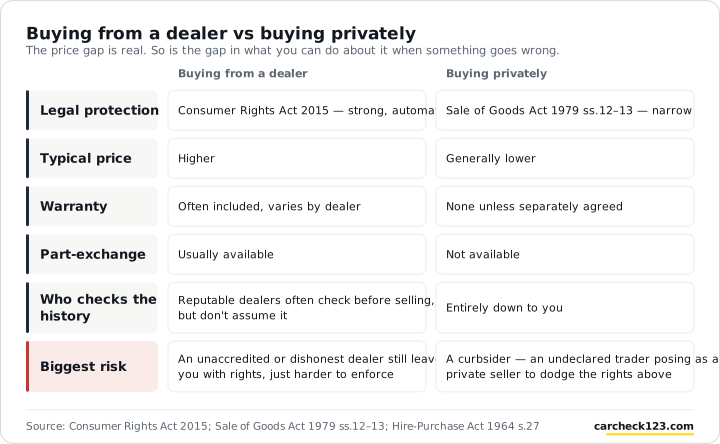
Dealer vs private seller at a glance
| Buying from a dealer | Buying privately | |
|---|---|---|
| Legal protection | Consumer Rights Act 2015: strong, automatic | Sale of Goods Act 1979 ss.12-13: narrow |
| Typical price | Higher | Generally lower |
| Warranty | Often included, varies by dealer | None unless separately agreed |
| Part-exchange | Usually available | Not available |
| Who checks the car's history | Reputable dealers often check before selling, but don't assume it | Entirely down to you |
| Biggest channel-specific risk | An unaccredited or dishonest dealer still leaves you with rights, just harder to enforce | A "curbsider": an undeclared trader posing as a private seller to dodge the rights above |
What legal protection you actually get — and give up
Buy from a dealer and the Consumer Rights Act 2015 covers you. The car has to be of satisfactory quality, fit for purpose and as described. If it isn't, you have a short-term right to reject it within 30 days. After that, you can require one repair-or-replace attempt.
A fault that shows up within six months of you taking delivery is presumed to have existed at the point of sale. That presumption holds unless the dealer proves otherwise. Any term that tries to sign these rights away isn't binding on you.
Buy privately and the Sale of Goods Act 1979 applies instead. It's much narrower. Its s.12 gives you the right that the seller actually owns the car and can sell it. Its s.13 says the car has to match its description.
Section 14 is the "satisfactory quality" section that does the heavy lifting in a dealer sale. It applies only to sales made "in the course of a business." A genuine private seller isn't caught by it at all.
Two protections apply whichever way you buy. Under the Road Traffic Act 1988 s.75, it's a criminal offence to sell a vehicle in an unroadworthy condition. That applies to anyone, dealer or private individual. It's separate from any contract claim you might have.
That offence doesn't apply if the car is explicitly sold for scrap, spares or off-road use and both sides know it.
The Misrepresentation Act 1967 gives you a route against any seller, private or trade, who actively lied about the car. A fault the seller genuinely didn't know about is different. It isn't misrepresentation. Our companion guide to selling a car privately covers these same obligations from the seller's side.
Is it safer to buy from a dealer or a private seller?
On paper, a dealer sale is safer. You have statutory recourse and a traceable business to pursue if something is wrong. Safer doesn't mean risk-free. A private sale from someone honestly selling their own car, properly checked, isn't reckless.
The sharpest risk that blurs the two channels is the "curbsider". That's an unlicensed or undeclared trader posing as a private individual, commonly on Facebook Marketplace, Gumtree or eBay. They do it to dodge the Consumer Rights Act obligations a declared trade sale would carry.
Trading Standards has warned about this pattern directly. A Welsh investigation looked at over 2,500 Facebook car adverts. One seller alone had advertised 90 cars in six months while presenting as a private individual.
Trading dealers must legally label their adverts as trade. A curbsider deliberately leaves it out. Watch for multiple ads under one contact, a seller who will only talk by text, or reluctance to meet at an address matching the V5C.
What's my comeback if a privately bought car breaks down?
It depends on what happened. If the seller actively lied, that's misrepresentation, and you have a claim under the Misrepresentation Act 1967. Saying the car had a full service history when it didn't would count. So would saying there was no accident damage when there was.
If the car simply develops a fault the seller genuinely didn't know about, that isn't misrepresentation. In that case you have very little comeback. Under SGA 1979, s.14's "satisfactory quality" duty doesn't apply to a private sale at all.
In practice, keep every message and the advert itself as evidence. Raise it with the seller directly first. If that goes nowhere, Citizens Advice can tell you whether small claims court is realistically worth pursuing for the amount involved. Usually it only is if you can show the seller genuinely misrepresented the car, rather than that the car turned out to have a problem.
Is it actually cheaper to buy privately?
Yes, it's widely reported. You'll see figures like "10-25% cheaper privately" quoted all over the place. Ignore the numbers.
We couldn't trace any of them to an independently conducted UK study. Every version we found traces back to unsourced marketing claims rather than a named dataset.
So treat "privately is usually cheaper" as a fair general expectation, not a figure to bank on for any specific car. The gap depends on the car, the seller, and how well you negotiate.
What warranty do you get, and what's it actually worth?
Many dealers include a discretionary warranty, and the terms vary hugely from dealer to dealer. Always check exactly what's covered and for how long. Check whether it's the dealer's own promise or backed by a separate warranty provider.
Your statutory rights under the Consumer Rights Act exist regardless of any warranty. A dealer warranty is extra cover on top, not a replacement for those rights, and a term trying to suggest otherwise isn't valid.
A private sale is, in the classic phrase, "sold as seen". There's no warranty at all unless you specifically agree one in writing. That's unusual in practice.
Does outstanding finance risk change by channel?
It's more nuanced than "private is riskier". Under the Hire-Purchase Act 1964 s.27, a private purchaser gets good title even though the finance hasn't been settled. That's a purchaser who buys the car in good faith, without notice of an existing hire-purchase agreement still owing on it. The finance company's claim doesn't follow the car to that buyer.
A motor trader who buys the car is explicitly excluded from that protection. But say that trader then sells it on to you, a genuine private buyer acting in good faith. You can still be the protected purchaser in that chain.
The key point: your own status as a good-faith buyer matters more than the channel you bought through. Run a finance check either way. Our Comprehensive check confirms outstanding finance directly, rather than leaving you to lean on legal protection after the fact. It matters more on a private purchase, since it does some of the protective work a dealer sale hands you automatically.
Start with our free car check for the basics on any car you're considering, from either channel.
Part-exchange only comes with a dealer purchase
Part-exchange only works with a dealer. A private seller has no equivalent way to take your old car off your hands as part of the deal. Only a dealer can take yours as partial payment.
Weighing up whether to part-exchange or sell your current car privately before buying your next one? A dedicated guide to part-exchange versus private sale covers that comparison from the seller's side.
Which is right for you
It comes down to one question. Does a straightforward comeback, if something goes wrong, matter more to you than price? If it does, a dealer sale gives you that as standard. If price matters more, a private sale can work out well and often be cheaper.
That means checking things yourself: running a proper history check, inspecting the car carefully, and staying alert to the curbsider pattern above. Either way, run a check on the specific car before you commit. It's the one step that narrows the gap between the two channels' actual risk.
FAQs
Is it safer to buy from a dealer or a private seller?
A dealer sale is safer on paper. You get automatic statutory rights and a traceable business to pursue. A private sale isn't automatically reckless, as long as the seller is genuine and you check the car properly. The main risk to watch for is a "curbsider". That's an undeclared trader posing as a private seller to avoid dealer obligations.
What's my comeback if a car I bought privately breaks down?
It depends on what the seller knew. Did they actively lie about the car, or was the fault one they genuinely didn't know about? An active lie is misrepresentation, which you can pursue. A fault nobody knew about leaves you very little comeback. That's because the "satisfactory quality" duty doesn't apply to private sales.
Do I get a warranty if I buy privately?
No. Not unless you specifically agree one in writing with the seller, and that's unusual. A private sale is generally "sold as seen".
Is it actually cheaper to buy from a private seller than a dealer?
Widely reported to be, yes. But we couldn't trace a specific percentage to any independently conducted UK study. Treat it as a fair general expectation rather than a number to rely on for a specific car.
How do I tell if a "private seller" is actually an undeclared trader?
Watch for multiple ads under one contact, a seller who will only talk by text, or reluctance to meet at an address matching the V5C. Genuine traders are legally required to label their adverts as trade sales.
Am I still at risk of buying a car with outstanding finance from a dealer?
The finance risk depends more on your own good-faith status as a buyer than on the channel. A genuine private purchaser acting in good faith is protected under the Hire-Purchase Act 1964. That holds even in a chain that includes a dealer. Running a finance check either way is still the sensible move, rather than relying on that protection after the fact.