
How to work through this checklist
Part of our guide to buying a used car. Ask these questions in the right order. A few checks from home, before you travel, rule out an obvious waste of time. At the viewing, the documents and the car itself need to tell the same story.
During the drive, a handful of specific things separate a sound car from a problem waiting to happen. Then, before you agree a price, the car's provenance matters more than almost anything else. Has it been written off, financed, stolen or clocked? Asking the seller won't settle that on its own: that's what a car check is for.
Work through the sections in that order and you'll catch nearly everything that trips buyers up.
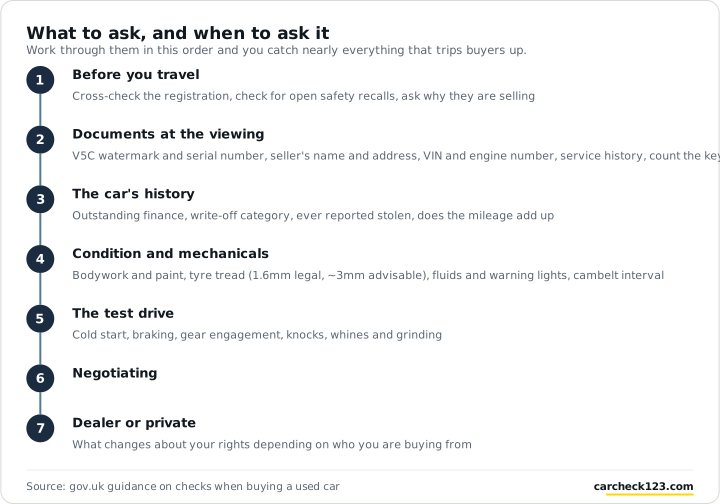
For the full walk-through, see how to buy a used car in the UK.
Before you travel to see it
Get the full registration, make, model and MOT test number from the seller before you arrange to view. Gov.uk says so.
Check the details you've been given against DVLA's records. Confirm the MOT status and history line up with what you've been told. And check the car hasn't been recalled for a safety defect.
- Cross-check the registration. Run it through our free car check. It confirms make, model and current MOT and tax status from the plate alone, so a mismatch shows up before you've left the house.
- Check for open safety recalls. Gov.uk's recall checker is free to use, and it covers recalls reported by participating UK vehicle manufacturers, which is the large majority of cars on the road. If there's an outstanding one, the fix is free whatever the car's age or mileage, but you shouldn't drive the car until it's done.
- Ask why they're selling and how long they've owned it. A short ownership window paired with a vague reason for selling is worth probing. It isn't necessarily a red flag on its own.
Documents to check at the viewing
Gov.uk's checklist is most specific here and worth following closely.
- Hold the V5C up to the light. Look for the "DVL" watermark. A logbook without it is a strong warning sign.
- Check the V5C's serial number isn't in a known stolen-blank range. Gov.uk names two ranges to watch for: BG8229501 to BG9999030, and BI2305501 to BI2800000. A V5C in either range may have been stolen blank, so report it to the police rather than proceed.
- Match the seller's name and address on the V5C to who you're actually meeting.
- Check the VIN and engine number against both the V5C and the physical car. They should match exactly.
- Ask for the service history, whether that's book stamps or digital records, and compare it with the MOT mileage history for consistency. More on that below.
- Count the keys. Two is standard. One on its own isn't a dealbreaker but is worth a question, and a replacement key can be a genuine expense.
Gov.uk's checklist stops there. It doesn't cover mileage consistency, outstanding finance, stolen or write-off status, or the test drive. That's deliberate, because the rest of this guide and a car history check cover those areas.
Questions about the car's history
These are the questions a seller's word alone can't settle. You need a check that pulls from DVLA, insurance and finance industry records.
- Is there outstanding finance on it? If the previous owner hasn't finished paying off a hire-purchase or PCP agreement, the finance company can in some circumstances still have a claim on the car, even after you've bought it. Our guide to outstanding finance sets out how the "innocent purchaser" protection actually works.
- Has it ever been written off, and what category? A Cat S or Cat N marker means the car was declared an insurance write-off and repaired. That isn't necessarily a dealbreaker, but you want to know before you buy rather than after. See insurance write-off categories explained, or the deep dives on Cat S and Cat N.
- Has it ever been reported stolen? Our guide to stolen car checks covers what a "stolen marker" actually means and how it's checked.
- Does the mileage add up across its MOT history? The MOT record shows the mileage logged at every test, and a drop or an implausible jump is the clearest free tell of tampering. See how to spot mileage clocking for the full walk-through.
Our free car check covers the MOT history and tax status. For finance, write-off and stolen status you need our Comprehensive check. The free check simply doesn't have access to that data.
Condition and mechanical checks
- Check the bodywork and paint for consistency. Panel gaps, colour mismatches between panels, or overspray on trim can point to accident repair.
- Tyre tread. The UK legal minimum is 1.6mm, measured across the central three-quarters of the tread around the whole tyre, and driving below that risks a fine and points per illegal tyre. Most tyre safety experts recommend replacing well before that, at around 3mm, since braking performance in the wet drops off well before the legal limit is reached. Don't take 3mm as the law. It isn't. It's the safety-recommended point to replace, and the two get mixed up on some ranking guides.
- Fluid levels and dashboard warning lights. A lit warning light the seller "knows about" is a negotiating point, not something to wave off.
- Cambelt, or timing belt. Ask if it's been done and when. Intervals vary a lot by make and model, broadly somewhere in a 60,000–100,000-mile or 5–10-year range, so check the specific schedule for that car rather than assuming a figure.
- Electrics and features. Windows, aircon, infotainment, central locking: test everything that's meant to work, in front of the seller.
The test drive
You only get a few minutes, so use the time to test a few specific things. Does it start cleanly from cold? Does it pull to one side under braking? Do all the gears engage smoothly?
Listen for noises that shouldn't be there: knocks over bumps, a whine from the gearbox, grinding from the brakes. A dedicated guide to test driving a used car covers this in more depth. It sets out what's normal wear and what should make you walk away.
Negotiating — questions that double as leverage
Everything you've found so far is leverage, not just information. An MOT advisory, a mileage that's higher than average, a gap in the service history: each one is a reason to ask about the price.
Ask directly: "Given the advisory/the mileage/the missing history, is there flexibility on the price?" A seller who's already had to answer your provenance questions honestly is in a weaker position on price. One who's never been asked isn't. A dedicated guide to used-car price negotiation goes through this in full.
Buying from a dealer vs a private seller — different questions
Some of these questions only make sense for one channel. A dealer sale is covered by the Consumer Rights Act 2015. The car has to be of satisfactory quality, fit for purpose and as described, with a right to reject, repair or refund if it isn't.
A private sale gives you narrower protection. Broadly, the seller has to have the right to sell the car and has to describe it accurately. There's no "satisfactory quality" guarantee in the way a trader sale has one.
That difference changes what's worth asking. From a dealer: what warranty comes with it, and what does it actually cover? From a private seller: how many previous owners does the V5C show, and can they show a continuous paper trail? A full comparison of buying from a dealer versus a private seller covers the practical differences in more depth.
FAQs
What's the single most important question to ask before buying a used car?
If you can only do one thing, run the registration through a free car check before you travel to see it. It confirms the make, model and current MOT and tax status from the plate alone. An obvious mismatch there saves you a wasted trip.
Do I need a history check if the seller shows me the V5C?
Yes. The V5C shows who the registered keeper is. It doesn't show outstanding finance, write-off history or a stolen marker. Only a dedicated check like our Comprehensive check covers those.
What if the seller can't find the V5C, or says it's "in the post"?
Treat this as a reason to pause, not proceed. Buy without a properly matching V5C in hand and you have no independent confirmation. You can't be sure the seller is who they say they are, or that the car is legitimately theirs to sell.
How many previous owners is normal for a used car?
It depends heavily on the car's age, and there's no single "normal" number. What matters more is whether the V5C and service history tell a consistent, traceable story. The raw count matters less than that.
Should I still get a check done if the car has a full service history?
Yes. A service history confirms maintenance, not provenance. It tells you nothing about outstanding finance, a write-off marker or a stolen report, which is exactly what a history check covers.
What questions should I ask differently when buying from a dealer vs a private seller?
From a dealer, ask about the warranty and exactly what it covers, since Consumer Rights Act 2015 protection sits behind it. From a private seller, ask more about the ownership and paper trail, since your legal comeback if something's wrong is narrower.