
What is an insurance write-off?
UK insurers use four write-off categories today: Cat A, Cat B, Cat S and Cat N. The letters grade the damage. They also set what can legally happen to the car afterwards.
Seen a category letter on a listing, an insurance renewal or a history check? This page is part of our guide to car history checks.
"Written off" sounds dramatic, but plenty of write-offs are barely damaged. An insurer writes a car off when fixing it would cost more than the car is worth. Or when it's too damaged to be safe.
On an older, low-value car, even a car park scrape can cross that line. So "written off" is a sums decision, not a verdict on the wreckage. If it's your own car that's just been written off, our guide to what happens next covers the payout offer and your options.
The definitions below come from the ABI Code of Practice for the Categorisation of Motorised Vehicle Salvage. It's the industry rulebook UK insurers use to grade written-off vehicles. It was last updated on 28 May 2025.
For the basics, see what a car history check is.
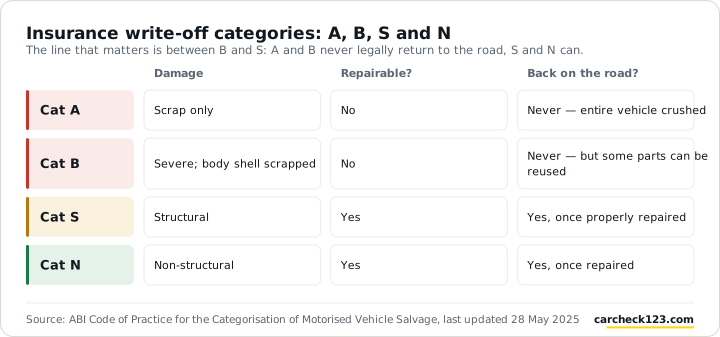
The four write-off categories at a glance
| Category | Damage | Repairable? | Back on the road? |
|---|---|---|---|
| Cat A | Scrap only | No | Never — entire vehicle crushed |
| Cat B | Severe; body shell scrapped | No | Never — but some parts can be reused |
| Cat S | Structural | Yes | Yes, once properly repaired |
| Cat N | Non-structural | Yes | Yes, once repaired |

Cat A — scrap only
Cat A is the worst grade. Gov.uk says the car "cannot be repaired" and the entire vehicle has to be crushed, including its parts. Nothing can be salvaged, and DVLA will never re-register it. A genuine Cat A vehicle should never turn up for sale as a runner.
Cat B — parts only, body shell crushed
A Cat B car also "cannot be repaired" and can never return to the road as a complete vehicle. One thing separates it from Cat A: you can salvage other parts from it.
The body shell still has to be crushed. But serviceable components such as the engine, gearbox, lights and electronics can be removed by a registered breaker. They can be reused in other cars.
You can legitimately buy a Cat B part, but you should never buy a Cat B car to drive.
Cat S — structural damage, repairable
The S stands for structural, meaning the damage reached a load-bearing part of the car: the chassis, frame or safety cell. It's repairable and can legally return to the road once it's been fixed properly.
Structural repairs are harder to do well and harder to check. So a Cat S car deserves a closer look than a Cat N one. Our page on what a Cat S car is covers the paperwork, the inspection and what to look for.
Cat N — non-structural damage, repairable
The N stands for non-structural. That means the car's structure and chassis were left intact, and the damage was to panels, lights, electrics or trim.
Don't read "non-structural" as "cosmetic". It tells you where the damage is, not how serious it was. Brakes, steering, suspension or airbags can all be part of a Cat N write-off.
It's repairable and road-legal once fixed, and our full guide on what a Cat N car is covers the buying checks in detail.
What happened to Cat C and Cat D?
Looking at an older car? You'll still see "Cat C" and "Cat D", which come from the old system.
On 1 October 2017, the ABI replaced Cat C and Cat D with Cat S and Cat N. The letters don't map across one for one. C and D compared the repair cost with the car's value; S and N grade the type of damage, structural or not. A car that would once have been a Cat C is a Cat N today if the damage wasn't structural.
The old markers weren't converted: a car categorised Cat C or Cat D before that date keeps its original marker for life. It doesn't become a Cat S or Cat N. So a pre-2017 Cat C or Cat D listing isn't a mistake. It uses the historic system.
Is a Cat S or Cat N car safe to buy?
It can be, as long as you know what you're buying. A well-repaired Cat S or Cat N car, priced to reflect its history, can be a genuine bargain.
The marker never comes off, so you're not paying for a clean history. You're paying for a car with a known past at a discount.
The category alone doesn't tell you whether this car was repaired well. That depends on the repair evidence, an independent inspection and the price. For more on both, see our guides to Cat S cars and Cat N cars.
How to check a car's write-off category before you buy
One thing catches a lot of buyers out. The free government check won't tell you whether a car has been written off.
Our free car check shows the MOT record, mileage and current tax status. It doesn't show a write-off either. That data sits on the insurance industry's total-loss register, not on DVLA's public record.
To see the category, you need a paid history check that draws on insurer-reported salvage data. Our Comprehensive check reports the write-off category: A, B, S or N. It also covers outstanding finance, stolen markers, mileage anomalies and previous keepers. You can see a sample Comprehensive check report before you buy one.
Your rights depend on who you buy from. Buy from a dealer, and the Consumer Rights Act 2015 requires the car to be of "satisfactory quality" and as described. An undisclosed write-off can give you grounds to complain.
A private seller isn't held to the same statutory standard, though they can still be liable if they actively lie about the car. Either way, checking the car yourself beats relying on a remedy afterwards.
How a write-off category affects you
Insurance
A previously written-off car must be declared to your insurer. It can cost more to cover. GOV.UK's own advice is to get a quote from an insurer before you buy. A saving on the purchase price is no use if a higher premium eats it up.
Finance
Financing a Cat S or Cat N car is often harder than financing a clean one. Some mainstream lenders decline or restrict lending on previously written-off vehicles. Specialist lenders may still fund one, often on tighter terms.
There's no single published rule here. So if you're borrowing, ask the lender to confirm they'll finance that specific car before you agree to buy it.
Resale value
The marker doesn't disappear after a good repair, so the next buyer sees it too. That means fewer buyers and less money than an equivalent car with a clean history.
You'll see exact percentages quoted online. Ignore them. Nobody publishes reliable numbers for this. Assume a meaningful discount when you buy, and expect to pass it on when you sell.
Selling a written-off car
Selling the car yourself? Don't hide the history. If you're a trader, deliberately leaving out a material fact like a write-off can fall foul of UK consumer-protection law. Since 6 April 2025, the relevant regime is the Digital Markets, Competition and Consumers Act 2024, which prohibits "misleading omissions" in a trader's dealings with a consumer.
A private seller sits outside that regime and has no legal duty to raise the category unprompted. Lie about it when you're asked, though, and you can still be liable. This is a general explanation, not legal advice. If you're unsure of your obligations, check gov.uk and Citizens Advice.
Transcript of the video
Every word in the video, in order. The video is silent, so this is the whole of it.
Beat 1 (0 to 6 seconds)
A write-off means the insurer paid out instead of repairing the car.
That's all it tells you. Not how bad the damage was.
Beat 2 (6 to 14 seconds)
Category S means structural damage. The frame or chassis was harmed.
It can go back on the road. But only if it's repaired to a roadworthy standard.
Beat 3 (14 to 22 seconds)
Category N means the damage wasn't structural.
It can still be serious.
Brakes, steering and airbags all sit outside the structural frame.
Beat 4 (22 to 31 seconds)
Before October 2017 the letters were C and D.
They compared repair cost with the car's value. Cat C meant more, Cat D meant less.
S and N measure damage instead. The letters don't map across.
Those cars are still on sale today.
Beat 5 (31 to 38 seconds)
DVLA records Category S on the V5C logbook.
It doesn't record Category N.
A private seller doesn't have to raise it.
Beat 6 (38 to 45 seconds)
A Comprehensive check tells you if a write-off is recorded against the car.
See if this car's been written off.
FAQs
What's the difference between Cat A, Cat B, Cat S and Cat N?
Cat A and Cat B cars must be destroyed and can never legally return to the road. The only difference is that Cat B parts can be reused. Cat S and Cat N can be repaired and driven again. Cat S involves structural damage to the chassis or another load-bearing part. Cat N doesn't involve structural damage.
Can a Cat A or Cat B car ever go back on the road?
No. They're both total losses that must be crushed, and DVLA won't re-register them. Only Cat S and Cat N cars can legally return to the road.
What happened to Cat C and Cat D?
On 1 October 2017, the ABI replaced Cat C and Cat D with Cat S and Cat N. The old letters don't map one for one onto the new ones. C and D compared the repair cost with the car's value; S and N grade the type of damage. Cars written off before that date keep their original marker, which doesn't convert.
Does a write-off category ever come off a car's record?
No. The marker is permanent, and a good repair, a fresh MOT or time won't remove it. That's why it keeps appearing on history checks.
How do I check a car's write-off category before I buy it?
The free government check won't show it. Use a paid history check such as our Comprehensive check, which reports the write-off category along with finance, mileage and stolen-vehicle data.