
What a VIN is
A VIN is a car's vehicle identification number. No two cars share one.
gov.uk puts the rule plainly: all vehicles registered in the UK must have a unique, stamped-in VIN and a registration number (gov.uk). It's usually stamped into the chassis.
Plenty of UK drivers call it the chassis number. It's the same thing.
It isn't the number plate. A plate can be transferred, retired or cloned, and swapping one is a known trick for making a car harder to trace. Our guide to number plate changes covers that side of it. The VIN stays with the metal.
This guide is part of our guide to car history checks. It covers what the characters mean, where the number hides on the car, and what to do when it doesn't match the paperwork.
One thing before the detail. A small number of cars can't prove their original VIN, usually after a rebuild, a restoration or a move of the number. DVLA assesses those vehicles and may require a replacement identity number instead. So "every car has a VIN" is nearly true rather than exactly true.
What the 17 characters mean
A modern VIN runs to 17 characters in three blocks. The GB rules for it sit in assimilated EU type-approval law (legislation.gov.uk).
The first three are the world manufacturer identifier, or WMI. A competent authority assigns it in the country where the maker has its main place of business. Very small makers are a special case. Where global production runs under 500 vehicles a year, the third character is always a 9, and the authority also assigns characters three to five of the last block.
The middle six are the vehicle descriptor section. They describe the vehicle's general characteristics. If a maker doesn't use all six, the rules let it fill the spare positions with characters of its own choosing.
The last eight are the vehicle indicator section. Its final four characters are digits only. The letters I, O and Q aren't permitted anywhere in the number.
Be careful with the decoding advice you'll read online. A check digit in position nine and a model-year code in position ten are United States federal requirements. A US import will carry them. The GB regulation asks for neither, so don't treat a UK-market car as suspect for lacking them.
Scope matters too. These are type-approval rules aimed at manufacturers, and they don't reach back through the whole car park. A 1968 classic was never in scope. Older vehicles often carry shorter chassis numbers, and that isn't a fault.
Where to find it on the car
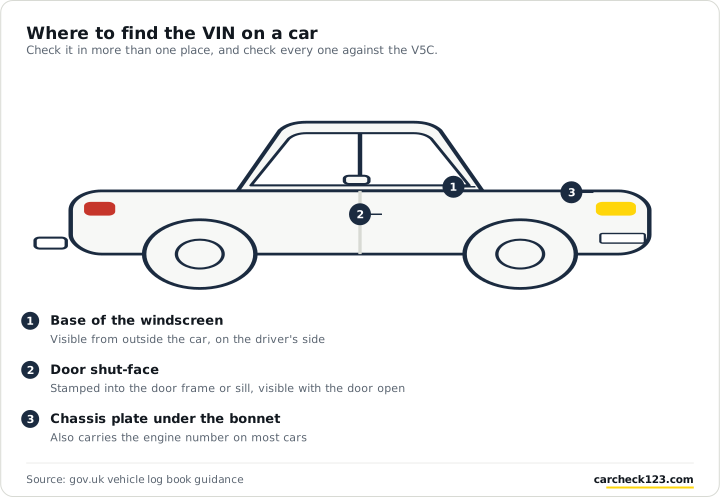
Three places on the car. Then a fourth on paper.
Two of them are labels you can read without tools. DVLA asks owners for a photo of the VIN sticker and says where to look. Near the driver's door or on the dashboard near the windscreen on the driver's side (gov.uk).
The third is the number stamped into the structure itself. The type-approval rules set those characters at no less than 7mm high, so it's meant to be read (legislation.gov.uk).
The stamped one is the one that counts. A sticker is a label; the stamp is part of the car.
The V5C, the logbook, also carries the VIN in its vehicle details. DVLA asks for the VIN or chassis number if you apply for a replacement V5C, and that usually costs £25 (gov.uk). Our
guide to V5C logbook checks covers the rest of the document.
Matching the car to the paperwork
The MOT test already does a version of this check. The tester must check the vehicle is displaying a legible VIN, and the defect table is public (gov.uk).
A VIN missing or not findable is a Major defect. So is one that's incomplete, illegible or obviously falsified. So is more than one different VIN displayed.
Two limits on that last one are worth knowing. Where a car shows the number in several places, only one has to be complete and legible, so a scuffed door sticker isn't a failure by itself. And multi-stage build vehicles are allowed two VINs, which may share their last eight digits. Two numbers on a van conversion isn't automatically the defect.
There's an age cut-off as well. Vehicles first used before 1 August 1980 sit outside the requirement to display a VIN. So do kit cars and amateur-built vehicles first used before 1 September 2001.
gov.uk's own used-car checklist puts this on the buyer. Check the vehicle identification number and engine number, it says, and make sure they match the details on the log book (gov.uk).
At a viewing, do this. Read the stamped number out loud, character by character, against the V5C. Check the windscreen and door plates against the same number. Photograph all of them so you can compare later without the seller watching.
If they don't match, I'd stop the viewing and ask for paperwork rather than walk off. There's an honest explanation for some mismatches, and it comes with documents you can see.
When a re-stamped VIN is legitimate
Replace a chassis, monocoque bodyshell or motorcycle frame like for like and DVLA treats it as a repair. You still have to tell them. That means form V627/1, the vehicle parts statement, sent in with the V5C, receipts for the replacement part, and photographs of the old VIN stamp and sticker (gov.uk).
DVLA then writes to confirm that the original VIN on the vehicle record can be stamped onto the replacement part. Any existing identification number already on that part has to be partially obliterated, by stamping a series of "––––" characters over it. Once DVLA has confirmation the original VIN has been re-stamped, it issues a new V5C carrying a marker in the Special Notes section.
So there are two documents to ask for. The DVLA authorisation letter and the V5C with that Special Notes marker. No paperwork, no deal.
Don't stretch this too far, though. It's the repair route, for a like-for-like replacement. Structural modification, kit builds and reconstructed classics run a different process, with different outcomes for the registration number. Only minor parts may be taken from a vehicle issued with a Certificate of Destruction.
There's also a marker you can see from the outside. Where a vehicle's age or identity is in doubt, DVLA issues a Q registration number. Any original registration number then becomes invalid, and you must not display it again (gov.uk).
What a free VIN decoder gives you
A decoder reads the manufacturer's specification. Engine, body style, market, that sort of thing. It knows nothing about theft, outstanding finance or a write-off, because none of that is encoded in the number. Those records live in separate databases.
Decoders guess more than they admit, too. The rules let a maker fill unused descriptor characters at its own discretion. So a generic decoder reading character five of a European car is reading a convention rather than a rule.
You probably can't look up a VIN from a number plate either. DVLA's public vehicle enquiry service takes a registration number, and what it gives back is this (gov.uk):
- vehicle tax
- SORN status
- when its MOT expires
- the date it was first registered
- last log book (V5C) issue date
- year of manufacture
- type approval category
- weight
- engine size
- fuel type
- emissions
- export status
No VIN in that list.
Sites promising an instant plate-to-VIN lookup aren't getting it from there. Your realistic routes to a VIN are the V5C, the car itself, and insurance or service paperwork. Writing to DVLA isn't one of them. That route is for a vehicle's keeper details, and you need a reasonable cause to use it (gov.uk).
Recall checks work the same way round. DVSA's service takes a car's registration number on its own, or the manufacturer, model and year of manufacture together (gov.uk). It covers safety recalls, and the manufacturer tells you about anything else.
Our Basic check gives you the end of the VIN, the engine number and the date on the car's valid V5C, where we hold them. It prints all three under a "Your checks" heading. It doesn't tell you they match. You do that bit, against the document and against the car.
The Comprehensive check carries the same panel. It adds finance, write-off, stolen and valuation data. None of that is in the number, so if the VIN is what you're after, Basic is the tier that answers it. The sample Basic report shows how the section reads.
Two limits, though. The end of a VIN isn't the whole VIN. And no check can see the metal, so put your own eyes on the stamped number too.
Common questions about VINs
Is the VIN the same as the chassis number?
In everyday use, yes. UK drivers say chassis number, and DVLA accepts the same wording: its replacement logbook page asks for "the VIN or chassis number". So use whichever word the person in front of you uses.
There's one nuance worth knowing. The 17-character format comes from type-approval rules for modern vehicles. An older car may carry a shorter stamped chassis number and be perfectly correct. That's age, not a fault.
Can I find a car's VIN from its number plate?
Not through DVLA's public service. Give it a registration number and it returns tax, SORN status, MOT expiry, first registration date, year of manufacture, engine size, fuel type, emissions and more. It doesn't return the VIN. You'll get that from the V5C, from insurance or service paperwork, or from the car itself. Sites offering an instant plate-to-VIN lookup aren't sourcing it from the government service. Ask the seller instead. An honest seller will read it out.
What does it mean if the VIN on the car doesn't match the V5C?
Treat it seriously and keep your money in your pocket. Don't walk off just yet, though. It can mean the paperwork belongs to a different car. It can also be legitimate, after a like-for-like chassis or bodyshell replacement that DVLA authorised. The honest version comes with a DVLA authorisation letter, and a V5C carrying a marker in its Special Notes section. Ask to see both before you go any further. No paperwork, no deal.
Do free VIN decoders show a car's history?
No. A decoder reads the build specification the manufacturer encoded into the number, so it can tell you about the engine or the body style. It has no access to theft records, finance agreements or write-off markers. Those come from a history check run against the vehicle's record, not from the number itself. Free is the clue. A decoder reads the spec, not the story.
Can a car's VIN ever change?
Rarely, and only with DVLA's agreement. Where a chassis or bodyshell is replaced, DVLA can authorise the original VIN being stamped onto the new part. Where the original VIN can't be proved, you have to apply for a replacement identity number instead. DVLA assesses the vehicle and sends an authorisation letter before anything gets stamped. None of that happens quietly. There's paper at every step, and you can ask to see it.