
What the V5C actually shows
A V5C, the logbook, is DVLA's registration document for the car in front of you. It shows who the registered keeper is and lists the vehicle's official details. It doesn't prove who owns the car. It also tells you nothing about outstanding finance, a write-off history or a clocked odometer.
This guide is part of our guide to car history checks. It covers what's printed on a V5C. It explains how to check one against the actual car before you hand over any money, and the red flags that suggest a logbook problem. It also covers two ways to get official information from DVLA yourself.
What's actually printed on it
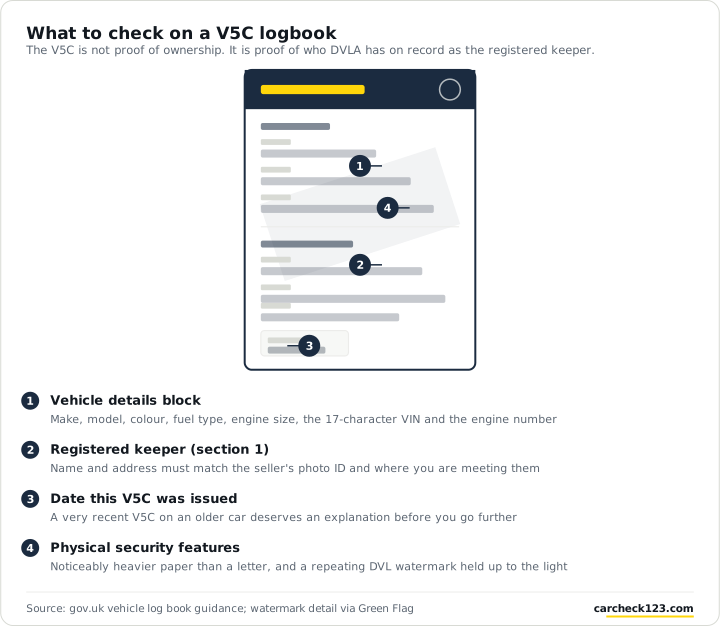
The document lists the details you'd check against the car. Make, model, colour, fuel type, engine size. The vehicle identification number (VIN) and engine number. When the car was first registered, and the date this particular V5C was issued.
Section 1 also carries the registered keeper's name and address.
Registered keeper, not owner
Plenty of guides get this wrong or skip it. A V5C confirms who is currently registered as the keeper. It doesn't confirm who owns the car. DVLA redesigned the certificate, the red version most cars carry today, specifically to stop buyers assuming otherwise.
The government said as much when it announced the change. The new document "carries a clear message on the front of it that it is not a proof of ownership" (gov.uk).
The registered keeper is simply the person responsible for the car day to day. That means taxing it, telling DVLA about changes and dealing with fines. Often that's also the person who owns it outright. Not always, though.
A car on finance is the common example. The finance company is the legal owner until the agreement is settled. The driver is only the keeper. Our guide to outstanding finance covers what that means if you're buying one.
For the basics, see what a car history check is.
How to check a V5C against the actual car
None of this takes long. Do it before you hand over a deposit, not after.
Cross-check the VIN
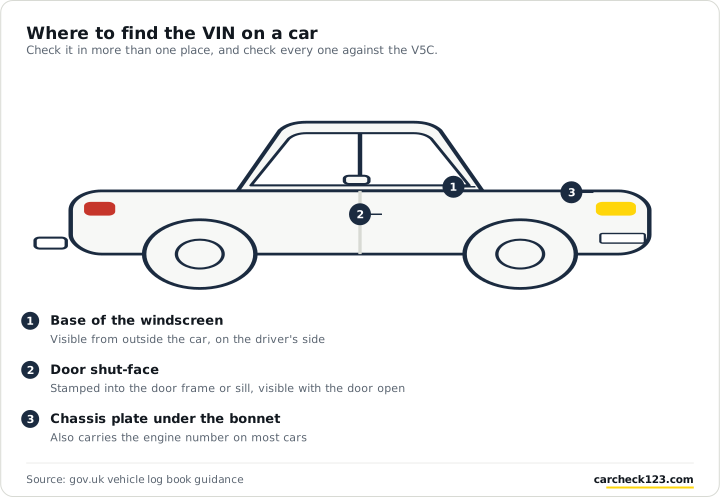
Find the 17-character vehicle identification number stamped on the car. Check that it matches the VIN printed on the V5C. It commonly sits at the base of the windscreen, on the door shut-face, and on a chassis plate under the bonnet. Check the engine number against the document too, if you can get to it.
Any mismatch is serious. It isn't just a paperwork slip. A VIN plate that looks re-stamped, scratched or replaced is just as serious.
Match the seller to the document
The name and address on the V5C should match the seller's photo ID, and the address should match where you're meeting them. A private seller who wants to meet somewhere other than their registered address is a major red flag. So is one who can't produce the V5C at all.
Physical security features
Genuine V5Cs issued since DVLA completed the national rollout of the red-design certificate in 2012 carry that "not proof of ownership" statement on the front. The "DVL" watermark is DVLA's own published check. Gov.uk's used-car buying guidance says to make sure the V5C has a "DVL" watermark (gov.uk). Hold the document up to the light to see it.
The same page lists two stolen serial-number ranges. Check the serial number isn't between BG8229501 and BG9999030, or between BI2305501 and BI2800000. If it is, the V5C might be stolen, so call the police as soon as it's safe to.
Motoring organisations such as Green Flag also describe the certificate as printed on noticeably heavier paper than a standard letter. That detail isn't on gov.uk, so treat it as a useful extra check rather than a definitive test.
These checks aren't foolproof on their own. But a document that looks thin, smudged or watermark-free, alongside a seller who's cagey about producing it, is one I'd walk away from.
Red flags that suggest a logbook problem
Mismatched details
Beyond the VIN, check that the make, model, colour and engine details on the V5C match the car in front of you. A respray or engine swap that was never declared to DVLA is a sign the paperwork hasn't kept pace with the car.
A high keeper count on a young car
Several registered keepers in a short time isn't automatically a problem. The car may have passed through a lease company or a dealer's stock. It's still worth asking about. Especially on a car that's only a couple of years old.
Stolen and cloned V5C documents
There's real history behind this. In 2006, a batch of blank DVLA log books was stolen after being rejected and returned to the supplier. Criminals then used them to "legitimise" the sale of stolen or cloned cars (gov.uk). That's what pushed DVLA to introduce the current red-design, more secure V5C.
Gov.uk does confirm specific stolen serial-number ranges on its used-car checks page. The physical security section earlier lists both ranges in full. A serial in either range means the V5C might be stolen, so call the police when it's safe to.
The point is simple. A logbook's physical condition and the security features described earlier matter. A seller who's evasive about a scruffy or unusually new-looking document is worth being wary of.
The New Keeper Supplement (V5C/2): what it is and why it matters
When a car changes hands, the seller (or trader) tells DVLA online at gov.uk/sold-bought-vehicle or by post. The buyer keeps the green slip torn from the back of the old V5C. That slip is the New Keeper Supplement, or V5C/2. Keep it until the full V5C arrives in your name.
That slip matters. Its 12-digit reference number is what lets you tax the car straight away, before the new V5C turns up. Gov.uk's own guidance says the same. It lists "the 12 digit reference number from the new keeper slip" as valid for taxing a vehicle you've just bought and don't yet have a V5C for (gov.uk).
Gov.uk says how long the new V5C takes after a sale. You'll usually get it within 4 weeks of the vehicle being registered to you (gov.uk). It can arrive in 5 to 7 working days, but only for a used vehicle whose seller registered the sale to you online.
A replacement logbook is a different thing with its own figures. Apply online for a replacement and it usually comes within 5 to 7 working days. Contact DVLA if nothing has arrived after 2 weeks.
After 6 weeks with no word from you, a replacement costs £25 (gov.uk). And a new keeper who never got a V5C can't use that online service anyway. That application goes by post.
The same caveat applies. The New Keeper Supplement is proof you're the registered keeper for tax and DVLA purposes. It isn't proof you own the car.
How to get vehicle information from DVLA directly
There are two separate ways to get DVLA data. Mixing them up is where a lot of guides go wrong.
The free public check
Gov.uk's free vehicle information checker works from a registration number. It gives anyone the tax and SORN (Statutory Off Road Notification) status, MOT expiry, first registration date, and the date of the last V5C. It also gives year of manufacture, type approval, weight, engine size, fuel type, emissions and export status (gov.uk).
It's useful and it's public. It doesn't show who the keeper is. For that, DVLA points you to a separate, restricted request.
Our own DVLA vehicle check tool shows much of that from just the registration. Tax status and when the tax is due, MOT status and expiry, and the make, model, colour and year. Fuel type, engine size and emissions come with it. So do the Euro standard and the Clean Air Zone charge that follows from it.
It's upfront about what DVLA doesn't hold. Finance, stolen and write-off data sit with lenders, the police and insurers. Want the full MOT record and a timeline of the car's paperwork life? Our free car check carries both, so you're not hopping between gov.uk pages to get them.
Keeper identity isn't in any of it. That has to come from DVLA directly, by the route below. Keeper count over time is a Basic check feature. More on that next.
Requesting keeper information — the restricted route
Sometimes you specifically need to know who's registered to a vehicle, say after a road traffic accident, or for another legally recognised reason. That's a separate application to DVLA, on the V888 form. You have to show "reasonable cause" for wanting it (gov.uk).
It isn't a casual way to look up "who owns the car I'm thinking of buying". DVLA's data protection obligations mean idle curiosity isn't reasonable cause.
What a history check adds that the V5C alone can't tell you
A V5C tells you what DVLA has on file today. That's all it does.
It won't tell you the car's full ownership timeline. It won't tell you whether the number plate's been swapped to make an older or higher-mileage car harder to trace. And it won't tell you whether it's got outstanding finance, a write-off record or a stolen marker against it.
Our Basic check gives you the end of the VIN, the engine number and the date on the car's valid V5C, where we hold them. It doesn't tell you they match. It prints them under a "Your checks" heading, so you can hold them against the document and the car yourself.
Our Comprehensive check carries the same panel. It adds finance, write-off and stolen data, plus a valuation and a mileage cross-check. The keeper panel and the plate-change row both sit one tier down, in the Basic check. The free check's timeline doesn't list plate changes, so don't lean on it to spot one.
The sample Comprehensive check report shows how it reads. Date on the valid V5C: 07/11/2020. Two previous keepers.
The current keeper got the car 25/10/2020, the one before 30/11/2018. First registration 26/04/2018. One plate change, DA120TG to ET11ANF, on 5 November 2020.
That's the kind of detail I'd want to compare with the V5C in front of me. No check can read the number stamped in the metal. Do that bit yourself.
V5C checks vs other red flags
Checking a logbook catches a specific set of problems: mismatched details, a document that doesn't look right, a seller who's evasive about it. It won't catch everything.
A clocked odometer can sit behind a perfectly genuine V5C. Our guide to spotting mileage clocking covers the separate checks for that. A stolen car can also come with a stolen or cloned V5C designed to look convincing. That's why our guide to stolen car checks is worth reading alongside this one, not instead of it.
FAQs
Is the V5C logbook proof that someone owns a car?
No. The V5C shows the registered keeper, the person responsible for taxing and running the car. It doesn't show who legally owns it. DVLA's own redesigned certificate carries a message on the front making that explicit.
What's the difference between the registered keeper and the legal owner?
The registered keeper is the person DVLA has down as responsible for the car day to day. The legal owner is whoever actually owns it. Usually that's the same person. On a financed car it isn't. The finance company owns the car until the agreement's paid off.
What is the New Keeper Supplement (V5C/2) and what do I do with it?
It's the green slip you get from the seller when you buy a car. You use it to tax the vehicle online before your own V5C arrives. Keep it until the new V5C turns up, usually within 4 weeks. That drops to 5 to 7 working days if the seller registered the sale to you online, so chase DVLA if it drags past the 4 weeks.
How do I check that a V5C logbook is genuine?
Cross-check the VIN on the car against the VIN on the V5C. Then check it's the red-design paper DVLA has used since 2012. Gov.uk says to look for a "DVL" watermark and to check the serial number against its stolen ranges. A seller who's reluctant to produce the V5C at all is a bigger warning sign than any single physical feature.
Can I get vehicle keeper information from DVLA myself?
Not casually. The free public checker deliberately excludes keeper identity. You need a separate DVLA application and a recognised reason. Being involved in a road traffic accident with the vehicle is one.
What should I do if a seller doesn't have the V5C, or it doesn't match the car?
Don't proceed if there's no V5C, the VIN doesn't match, or the seller's details don't line up with their ID. Any of those is a reason to walk away rather than talk yourself into a deal. Our guide to buying a car without a V5C covers DVLA's advice.