
How VED works
Car tax is officially Vehicle Excise Duty, or VED. It's based mainly on a car's CO2 emissions and first registration date. For most cars registered since April 2017, you pay a higher rate in the first year, based on emissions. After that, it's a flat standard rate of £200 a year from the second year onwards.
Older cars use different systems. You'll see them below.
If you're buying second-hand, what matters most isn't in the rate tables at all. Car tax doesn't transfer to you when you buy a car. The seller's tax is cancelled the moment the sale is registered. You have to tax it in your own name before you drive it away.
There's no grace period. Every rival guide seems to skip that.
This piece is part of our guide to MOT, road tax and staying legal. For the overview, see staying legal with a used car.
What changed on 1 April 2026
All VED rates below are the figures set for the 2026 to 2027 tax year (1 April 2026 to 31 March 2027), verified against gov.uk. Rates are usually uprated each April and can change at a Budget, so re-check this whole section before then.
Three changes matter for most people:
- The standard rate went up by £5, from £195 to £200 a year. That's the flat rate most cars registered on or after 1 April 2017 pay from their second year onwards, whatever the fuel.
- The Expensive Car Supplement threshold for electric cars rose from £40,000 to £50,000. Only EVs registered on or after 1 April 2025 pay that supplement at all, and they now escape it below £50,000. For petrol, diesel and hybrid cars the threshold stays at £40,000.
- Electric cars still pay tax. The old free ride ended on 1 April 2025, not 2026, so older guides saying EVs are exempt are out of date. An EV registered since then pays a £10 first-year rate, then £200 a year like everyone else. Older ones pay less. An EV registered between 1 March 2001 and 31 March 2017 sits in band A, at £20 a year.
Much of the confusion online comes from mixing up two sets of changes. April 2025 is when EV tax started and low-emission first-year rates jumped. The list above covers April 2026. Every rate in this guide has its year attached for that reason.
How VED bands work for cars registered from April 2017
Cars first registered on or after 1 April 2017 follow a two-stage system.
Year one is the "showroom tax". The first year's rate is based on the car's official CO2 emissions. It's usually rolled into the on-the-road price of a new car, so it mostly matters if you're buying something nearly new. The 2026/27 first-year rates run like this:
| CO2 emissions | First-year rate (petrol, RDE2 diesel, alternative fuel or electric) |
|---|---|
| 0 g/km | £10 |
| 1–50 g/km | £115 |
| 51–75 g/km | £135 |
| 76–90 g/km | £280 |
| 91–100 g/km | £365 |
| 101–110 g/km | £405 |
| 111–130 g/km | £455 |
| 131–150 g/km | £560 |
| 151–170 g/km | £1,410 |
| 171–190 g/km | £2,270 |
| 191–225 g/km | £3,420 |
| 226–255 g/km | £4,850 |
| Over 255 g/km | £5,690 |
Diesels that don't meet the "RDE2" standard pay the rate one band higher. RDE2 is Real Driving Emissions Step 2, the current test for nitrogen oxide emissions. The first-year charge tops out at £5,690 for the highest-emitting cars.
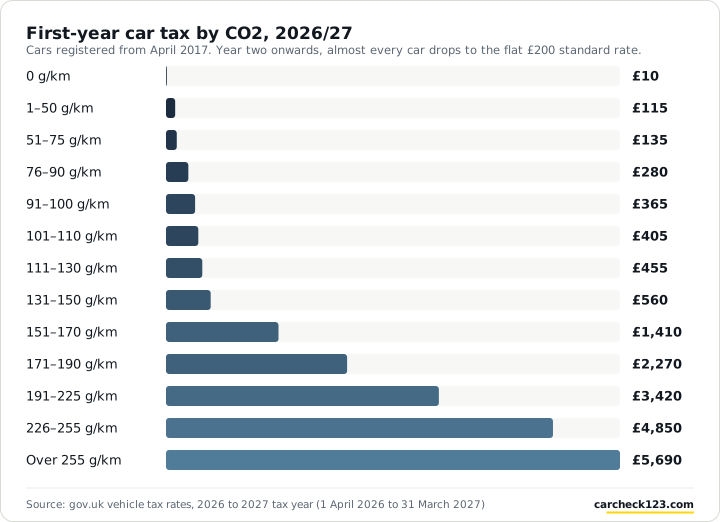
From year two onwards, it's the standard rate. Almost every car drops to a flat £200 a year (£210 if you spread it over monthly Direct Debit payments, or £110 for six months). It doesn't matter whether the car does 40 g/km or 240 g/km. The rate is the same.
This is the number that matters most when you're buying used. Any car more than a year old is already on it.
The Expensive Car Supplement
If a car had a list price of more than £40,000 when new, there's an extra charge on top of the standard rate. It's £440 a year for five years, from the second time the car is taxed. So years two to six. For an affected petrol or diesel car that's £640 a year in total during those years.
Electric cars work differently, and this is what matters on a used forecourt. A zero-emission car registered before 1 April 2025 doesn't pay the supplement at all. It makes no difference what it cost new. gov.uk sets out both conditions: you don't pay it if the vehicle is zero emission and it was registered before 1 April 2025.
So a 2022 EV that listed at £60,000 owes nothing extra. It just pays the £200 standard rate.
An EV registered on or after 1 April 2025 does pay the supplement, above a £50,000 list price. That threshold rose from £40,000 on 1 April 2026. For petrol, diesel and hybrid cars it stays at £40,000.
It's based on the original list price, not what you're paying now.
Older cars: tax bands before April 2017
Much of the used market falls below the April 2017 line. These cars work differently. They pay a single annual rate, with no separate first-year charge.
Cars registered 1 March 2001 to 31 March 2017 use CO2 bands lettered A to M. For 2026/27 the annual rates run from £20 (bands A and B, up to 110 g/km) up to £790 (band M, over 255 g/km). Most ordinary family cars land somewhere in the £170–£445 range.
There's a cut-off inside that top end. A car registered before 23 March 2006 can't go past band K, £445 a year, however much CO2 it puts out. The £760 and £790 bands only catch cars registered on or after that date. So a thirsty V8 from 2004 costs less to tax than the same car from 2007.
The old £0 band A no longer exists. Even the cleanest cars in this group now pay £20.
Cars registered before 1 March 2001 are taxed on engine size alone. It's £230 a year for engines up to 1549cc, and £375 a year for anything over 1549cc.
Buying a used car? Tax does not transfer with it
This is the bit rival guides bury. When you buy a used car:
- The seller's tax is cancelled automatically. As soon as they tell DVLA they've sold it, the tax is stopped and they get a refund for any full months left. gov.uk is blunt about it: "The tax is not transferred to you when you buy the vehicle."
- You must tax it before you drive it. In gov.uk's words: "You must tax a vehicle you've bought before you drive it, or declare it off the road (a SORN)." SORN is short for Statutory Off Road Notification, and we cover it below. There is no grace period, not even a day to drive it home on the old keeper's tax.
- You can tax it on the spot using the 12-digit reference number on the green "new keeper" slip (V5C/2) the seller hands you. Do it online or by phone before you set off. It takes effect immediately. DVLA's target is to let you tax through its online account by March 2027.
Drive away on the seller's tax and the car is untaxed as far as the law is concerned. The refund has already gone back to them. So budget the tax in before you agree a price, and let a high-emissions band shape what you offer.
How to check a car's tax status and band before you buy
You don't have to take the seller's word for any of this. Our free car check needs just the number plate. It shows whether the car is currently taxed, alongside its MOT record. It doesn't tell a SORN from an untaxed car, so if the tax has run out, check gov.uk's vehicle tax checker.
If a car shows as SORN or untaxed, ask why.
For the full test history, use our MOT check.
While you're there, do one more check. If you'll be driving it in London or another city with a charging zone, run the registration through our ULEZ check. An older diesel that's cheap to buy can be expensive to drive daily if it isn't compliant. Our guide to ULEZ and clean air zones sets out which schemes charge what.
Electric and low-emission car tax in 2026
Electric cars are no longer tax-free, but they are still cheap to tax:
- First year: £10 for a zero-emission car registered on or after 1 April 2025.
- Standard rate: the same £200 a year as petrol and diesel, from the second year. An EV registered between 1 April 2017 and 31 March 2025 goes straight onto it. An EV from the 2001 to 2017 era is in the old band A instead, at £20 a year.
- Expensive Car Supplement: only for an EV registered on or after 1 April 2025, and only above a £50,000 list price. An EV registered before that date is exempt, whatever it cost new. It's £440 a year for years two to six, and the threshold rose from £40,000 on 1 April 2026.
You may also hear about "pay-per-mile" car tax for electric cars, known as eVED. It isn't yet in force. Nothing is payable now or in the 2026/27 tax year.
After the consultation, the government confirmed its plans in a response published in July 2026. It intends to charge electric cars 3p per mile, and plug-in hybrids 1.5p per mile, from April 2028. That's still a future change, not a current cost. Older coverage treating it as something you pay today is wrong.
What happens if you don't pay
Keeping or driving an untaxed car on a public road is an offence. DVLA relies mostly on number-plate cameras, so untaxed cars are spotted quickly. Based on DVLA's enforcement policy:
- An automatic penalty of £80 for keeping an untaxed vehicle, reduced to £40 if you pay within 33 days.
- An out-of-court settlement of £30 plus one and a half times the outstanding tax if the car is caught being used on the road.
- Clamping and impounding. A clamped car costs £100 to release within the first 24 hours. If it's impounded, that's a £200 release fee plus £21 a day storage, and a surety fee (from £160 for a normal car) that you get back later.
- Court action if the settlement goes unpaid, with a fine of £1,000 or five times the annual tax, whichever is greater.
Keeping a car but not using it on the road? The legal alternative to taxing it is a SORN, a Statutory Off Road Notification. You declare it off the road with DVLA, stop paying tax, and get a refund for the full months left. The car has to be kept somewhere like a garage, drive or private land, never on a public road.
Then keep it off the road. Driving a SORN'd car is punished harder than letting the tax lapse. The out-of-court settlement is £30 plus twice the outstanding tax. Court can mean up to £2,500.
See our guide to SORN explained for how and when to use it.
There's one more exemption worth knowing. Genuinely old cars are tax-exempt on a rolling 40-year basis. For the year from 1 April 2026, a car built before 1 January 1986 can be taxed at £0. You still have to apply for the exemption and tax it each year, and it isn't automatic.
It doesn't cover a car used commercially, or for hire and reward. A classic taxi is out.
FAQs
Does road tax transfer when you buy a used car?
No. gov.uk says plainly that "the tax is not transferred to you when you buy the vehicle." The seller's tax is cancelled when they report the sale, so you tax it in your own name, in advance. Use the new keeper slip to do it before driving away.
How much is car tax for a used petrol or diesel car in 2026?
For most cars registered from April 2017, it's the flat standard rate of £200 a year from year two. Cars registered 2001–2017 pay a CO2-banded annual rate from £20 to £790. Pre-2001 cars pay £230 or £375, depending on engine size.
How much is car tax on an electric car in 2026?
£10 in the first year and £200 a year after that, the same standard rate as petrol and diesel. The £10 first-year rate applies to EVs registered on or after 1 April 2025. Add £440 a year in years two to six if the car was registered on or after that date and the list price was over £50,000. An EV registered before 1 April 2025 doesn't pay that supplement at all, whatever it cost new. An EV registered between 1 March 2001 and 31 March 2017 is cheaper still, at £20 a year.
What happens if I drive a car with no tax?
You risk an £80 penalty, reduced to £40 if you pay quickly. If you're caught using it on the road, it's £30 plus one and a half times the tax instead. Clamping or impounding is possible too. Prosecution can mean a fine of £1,000 or five times the tax.
How do I check if a car I'm about to buy is taxed?
Enter the number plate into our free car check. It tells you whether the car is taxed, alongside its full MOT history. To see whether an untaxed car is declared SORN, use gov.uk's vehicle tax checker.
What changed with car tax from 1 April 2026?
The standard rate rose from £195 to £200, and the Expensive Car Supplement threshold for electric cars rose from £40,000 to £50,000. Electric cars have paid tax since April 2025.