
How many cars fail their MOT first time?
In the 2025 to 2026 financial year, 27.51% of cars failed their MOT first time, according to the DVSA's MOT testing data for Great Britain. That's a bit more than one car in four. The "one in three" figure repeated across lots of car blogs is still higher than the official number. Below are the faults that actually fail cars, ranked by frequency, plus how to spot each one early.
This covers actual failures, not advisories. An advisory is a tester's note that something is wearing but isn't bad enough to fail the car, so it's a different thing. We cover those in MOT advisories explained.
For the 2025 to 2026 financial year, the DVSA recorded an initial failure rate of 27.51% for the class that covers cars. That rate covers 33.3 million tests.
The rate has fallen steadily for a decade. It was 40.00% in 2013 to 2014 and 31.69% in 2019 to 2020, so cars now fail roughly a third less often than they did twelve years ago. The one interruption came in 2023 to 2024, when the rate ticked up before the fall resumed.
The DVSA counts it this way. It reports classes 3 and 4 together, meaning "cars, vans and passenger vehicles with up to 12 seats". So the figure covers ordinary cars alongside light vans and small passenger vehicles, not cars in complete isolation. It's still the closest official answer to "will my car pass?", and it comes from the DVSA's published statistics rather than a garage's estimate.
The word "initial" matters. Some of those cars pass on the same visit, once a minor fault is fixed at the test station, so the number of cars that ultimately remain failed is lower. But the initial rate is the honest one for a buyer or owner. It's the share of cars that turn up and don't pass as they are.
Part of our guide to MOT, road tax and staying legal.
The most common MOT failure categories, ranked
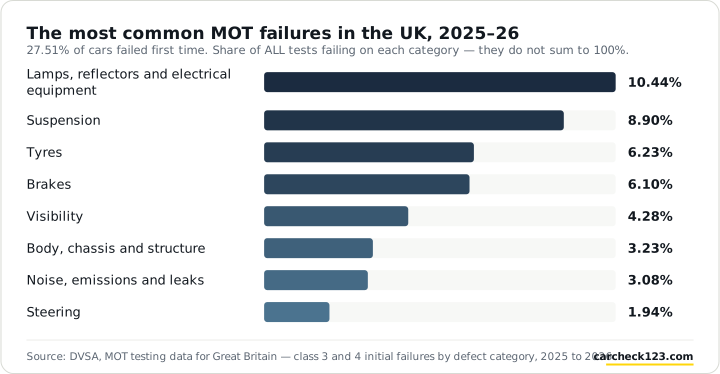
Below are the defect categories cars fail on most often. They come from the DVSA's "class 3 and 4 vehicles: initial failures by defect category" data for the 2025 to 2026 financial year.
A note on these percentages. Each figure is the share of all tests that failed on that category. So 10.44% means roughly one car in ten tested failed on lighting somewhere.
They don't add up to 100%, and they're not meant to. Most cars pass, and a single failed car can fail on several categories at once. Read them as "how likely is a car to trip up here", not as slices of a single pie.
| Failure category | Share of all tests failing on it (2025–26) |
|---|---|
| Lamps, reflectors and electrical equipment | 10.44% |
| Suspension | 8.90% |
| Tyres | 6.23% |
| Brakes | 6.10% |
| Visibility | 4.28% |
| Body, chassis and structure | 3.23% |
| Noise, emissions and leaks | 3.08% |
| Steering | 1.94% |
Lighting and signalling
Lighting tops the table every year, and it's the easiest of the lot to avoid. A blown bulb, a dead indicator, a misaligned headlight, a cracked lens or a number-plate lamp that's stopped working will all fail a car. It's easy to miss because you rarely see your own lights working from the driver's seat.
If you've fitted LED bulbs to halogen headlamps, read the MOT rule for them from 14 October 2026.
Suspension
Suspension is second, but much harder to check yourself than lighting. Failures come from worn shock absorbers, tired bushes, corroded or broken springs, and play in the joints. These faults develop slowly as a car ages.
Pre-check: listen for knocks or clonks over speed bumps and potholes. Look underneath for obvious corrosion or fluid leaking from a shock absorber. Uneven tyre wear across the tread is often the first visible sign that something in the suspension or steering isn't right.
Tyres
Tyres come third. They overtook brakes in the 2025–26 data, for the first time since the figures begin in 2013, and we've set out what changed and what didn't. Unlike suspension, the rule here is a hard legal line.
The MOT inspection manual requires the tread to be at least 1.6mm deep. That applies within the central three-quarters of the breadth of the tread, and around the entire outer circumference of the tyre. Below that the car fails. So does a bulge, a cut deep enough to reach the cords, or the wrong type of tyre fitted.
Brakes
Brakes wear fast, and they're safety items. It's no surprise they sit this high. Worn pads or discs, an ineffective handbrake, or a braking imbalance between the wheels will all fail a car.
Visibility
Visibility failures are about the driver's view of the road. A chip or crack in the windscreen counts if it sits within the area the wipers sweep and affects the driver's view of the road. So does a wiper that doesn't work, or a blade that's missing or obviously not clearing the screen. Washers that don't work, or don't spray enough to clear it, fail too.
They're all cheap to fix and easy to forget. A worn blade that still clears the screen is usually only a minor defect, so the car passes with it noted on the certificate.
Pre-check: top up the screenwash, test the washers and wipers, and look closely at the glass in front of the driver. If it affects your view of the road, a chip larger than 10mm in the driver's central view is a fail, and so is 40mm anywhere in the swept area. I'd get chips looked at early, before they spread.
Structure, emissions and the rest
Further down the DVSA's ranking, but worth knowing: body, chassis and structure failures, noise and emissions failures, and steering faults. The first of those is usually corrosion near a structural or load-bearing brake or suspension mounting point.
Number-plate condition, seat belts and mirrors sit lower still, but they do catch cars out. They're grouped here because they're less common than the top five, not because they're minor. A structural corrosion fail can cost real money.
Why these faults happen — the pattern behind the numbers
There's a pattern at the top of that list. Lighting, suspension, tyres, brakes and wiper visibility are all consumable, wear-and-tear items. They aren't one-off mechanical disasters. They're the parts that quietly wear out on every car and need routine attention.
That's good news. Most MOT failures come down to basic upkeep rather than bad luck. A bulb, a set of wiper blades, some screenwash and a tyre-tread check together cover a big share of the reasons cars fail. The cars that sail through belong to owners who keep on top of those small jobs.
Buying a used car? What a failure pattern can tell you
Weighing up a used car instead of preparing your own for an MOT? Read those categories differently. A car's MOT history shows whether it passed, what it failed on and when. The pattern matters more than any single line.
A one-off brake failure that was fixed and retested is normal ownership. The same category failing again and again is a different story. Say the brakes failed at two of the last three tests, or corrosion cropped up more than once.
That points to a car that's been run hard or maintained on the cheap. Look more closely and use it as a negotiating point. It isn't automatically a reason to walk away.
That's a different signal from advisories, which flag things that were wearing but didn't fail. Our MOT advisories explained guide covers how to read those. For actual failures, you want the full test record.
Our free MOT check tool pulls a car's complete MOT history using just the number plate, including every pass and fail and the reasons for any failure. You can spot a repeat-failure pattern before you hand over any money.
How to avoid an MOT failure: a pre-test checklist
Twenty minutes at the weekend before your test covers most of the common failures:
- Lights: walk round with everything switched on. Sidelights, dipped and main beam, indicators, hazards, brake lights, fog lights and the number-plate lamp. Replace any dead bulbs.
- Tyres: do the 20p test around each tyre and check for cuts, bulges and uneven wear. Don't forget tyre pressures.
- Visibility: top up the screenwash, check the washers spray and the wipers don't smear, and look for chips or cracks in the driver's view.
- Brakes: listen for grinding and feel for pulling or a soft pedal on your next drive. Check the handbrake holds on a slope.
- Suspension: listen for knocks over bumps and glance underneath for leaks or heavy corrosion.
- Number plate and screen: make sure plates are clean, secure and legible, and the windscreen is clear.
None of this guarantees a pass. A hidden brake or suspension fault can still stop the car. But it clears the faults that make up most of the DVSA's failure list.
FAQs
What is the most common reason cars fail their MOT?
Lighting and signalling: bulbs, indicators, headlight alignment and number-plate lamps. It's the biggest failure category in the DVSA's data every year, and one of the cheapest to fix.
What percentage of cars fail their MOT first time?
In the 2025 to 2026 financial year, 27.51% of cars failed at the first attempt, according to DVSA statistics. That's a bit more than one in four. The often-quoted "one in three" is still higher than the official figure.
Is a cracked windscreen an automatic MOT failure?
Not always. It depends on size and position. Damage larger than 10mm in the driver's central view, or 40mm anywhere in the area swept by the wipers, is a failure if it affects the driver's view. A small chip low on the passenger side may not be, though it's worth fixing before it spreads.
What's the difference between an MOT failure and an advisory?
A failure comes from a dangerous or major defect and stops the car passing. An advisory is just a note that something is wearing but isn't bad enough to fail. A car can pass with a page of advisories. See MOT advisories explained.
Can I drive my car home if it fails its MOT?
Only in narrow circumstances. If your old MOT is still valid you can generally drive it. But if the car has been failed on a dangerous defect, you must not drive it until it's repaired. Driving a vehicle in a dangerous condition is an offence.
How can I check if a used car has failed an MOT before?
Run the number plate through our free MOT check tool. It shows the car's full test history, including past failures and the exact reasons for them, so you can see whether the same fault keeps coming back.