
There's no single trustworthy age-by-fault table
No official table says "at year X, component Y breaks". DVSA publishes MOT failures by defect category across the whole fleet. It doesn't break them down by vehicle age.
Some sites present their own analysis of DVSA's raw open data as if it had DVSA's authority. Those versions don't even agree.
Three things are safe to say. DVSA's own data shows which components fail MOTs most often, UK-wide, at any age. An independent Which? survey shows how reliability and running costs shift across three age brackets, and the shift is smaller than most people assume. Some wear items have well-established lifespans shaped more by age than mileage.
Part of our guide to running a car.
Does a car really get less reliable with age?
Not by much. Which?'s Car Survey (fieldwork April-June 2025, 63,334 drivers reporting on 72,470 cars) splits cars into 0-4, 5-9 and 10-15-year age bands. The breakdown rate rises from 11% for cars aged 0-4 years to 12% for cars aged 10-15 years. That's a real difference, but it's a long way short of what the "old car = money pit" assumption suggests.
Average repair cost rises from £365 to £377 across the same brackets. Servicing costs less for the older bracket, at £290 against £318.
Which? also found well-maintained older models beating near-new cars outright. Some models over 10 years old had zero reported breakdowns in the past year, and repair times far below their age bracket's average. So age alone is a weak predictor of reliability. How a specific car has been looked after matters more.
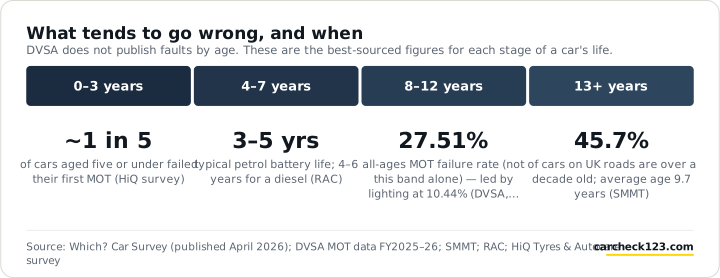
0-3 years — still under warranty, low-fault years
Not much goes wrong in this window. Most problems are covered by the manufacturer's warranty. Our guide to used car warranty options covers what's usually still in place at this age. The first MOT test isn't due until a car turns three years old.
Newer doesn't mean trouble-free, though. A HiQ Tyres & Autocare survey found roughly one in five cars aged five or under failed their first MOT. It's HiQ's own survey data rather than a DVSA or government figure, so read it as an indicator rather than a hard statistic.
4-7 years — warranty expiry and the first wear items
Manufacturer warranty cover usually runs out during this window. The first wear items start needing attention.
Batteries are a common example. RAC's own guidance puts a typical petrol car battery's lifespan at roughly 3-5 years. RAC puts a diesel's at roughly 4-6 years, since diesel batteries tend to be larger and work harder. Hybrid batteries commonly last 8-10 years, or 100,000-150,000 miles.
Brake pads, discs and tyres are genuine wear items by now, not "new car" parts. The first MOT advisories tend to appear on a car's record around this point too. Our guide to MOT advisories explained covers what an advisory means and how seriously to take one.
8-12 years — running costs start to shift
This bracket straddles Which?'s 5-9 and 10-15-year survey bands. Those bands are the honest guide for this age range. Nobody publishes an "X% of 10-year-olds need Y repair" figure worth quoting.
We do have the fleet-wide picture. DVSA's own data (FY2025-26) puts the overall Class 3 & 4 initial failure rate at 27.51%. The leading defect categories are lighting/electrical (10.44% of tests), suspension (8.90%), tyres (6.23%) and brakes (6.10%).
Those figures aren't age-specific because DVSA doesn't publish that breakdown. It's still a genuine, checkable picture of what goes wrong on UK cars generally, which beats an invented age-specific number.
Mileage shapes fault patterns as much as age does. A high-mileage 5-year-old and a low-mileage 15-year-old fail for different reasons. Our guide to mileage clocking and our companion piece on what mileage is too high for a used car explain that side in more detail.
13+ years — keeping an older car on the road
By now, the question shifts from "what breaks" to "what does it cost to keep going?" Corrosion and general wear matter more across the fleet at this age. No official age-specific figure pins down how much more likely, so treat it as a well-established general pattern rather than a precise statistic.
Which?'s 10-15-year data still shows well-maintained examples outperforming near-new cars. Age alone isn't a verdict.
A full service history is one of the best predictors of whether an older car is a safe bet. Our companion guide to what good service history looks like explains how to check one rather than take a seller's word for it.
Cars this age are now mainstream, not fringe. SMMT's own data puts the average UK car at 9.7 years old, with 45.7% of cars on UK roads now over a decade old.
Age or mileage — which matters more?
Both, and they aren't the same thing. A low-mileage 15-year-old car and a high-mileage 5-year-old car tend to fail for different reasons. One suffers age-related wear on parts that degrade whether you drive or not, like rubber seals and batteries. The other has use-related wear on the clutch, brakes and suspension bushes.
Our guide to mileage clocking and our companion piece on what mileage is too high for a used car explain the distinction in more detail.
How to check before you buy or keep an older car
Age brackets only take you so far. Our Comprehensive check gives you a specific car's complete MOT history, so you can read that car's own pattern of advisories and failures. On anything over about ten years old, I'd read the MOT history before I read the advert.
Then run our free check's running-costs estimator to budget for fuel, road tax and the MOT. It doesn't include maintenance, and that matters most on an older car, so budget for servicing and repairs on top.
FAQs
What breaks first on an older car?
There's no single official answer, but batteries, brake pads, discs and tyres are typically the first genuine wear items. They show up from around 4-7 years. Beyond that, DVSA's overall MOT data shows lighting/electrical, suspension, tyres and brakes as the most common defect categories across the whole fleet. That data isn't age-specific.
Is a 10-year-old car still reliable enough to buy?
Often, yes. Which?'s Car Survey found the breakdown rate rises only from 11% (0-4 years) to 12% (10-15 years). That's a real gap, but a small one. Specific well-maintained older models outperformed near-new cars outright. How well a car has been looked after matters more than its age alone.
Do cars really get less reliable with age, or is that a myth?
There's a real effect, but it's smaller than most people assume. Age on its own is a weak predictor. Service history and how the car's actually been looked after tell you more than the year on the registration plate.
Which matters more for reliability — a car's age or its mileage?
Both, for different reasons. Age-related wear on seals and batteries happens regardless of use, while mileage-related wear on brakes, clutch and suspension happens through use. A low-mileage older car and a high-mileage newer car fail differently, not necessarily worse or better than each other.
How much should I budget for repairs on an older used car?
There's no fixed figure, and our free check's running-costs estimator doesn't include maintenance. Start from the car's own MOT history and service record. Allow more in your budget for an older car with a patchy service history.
How do I check a specific car's MOT and fault history before buying it?
Our Comprehensive check shows a specific car's complete MOT history. So you can see its own advisory and failure pattern, rather than relying on general age-bracket guidance.