
What you're legally required to do
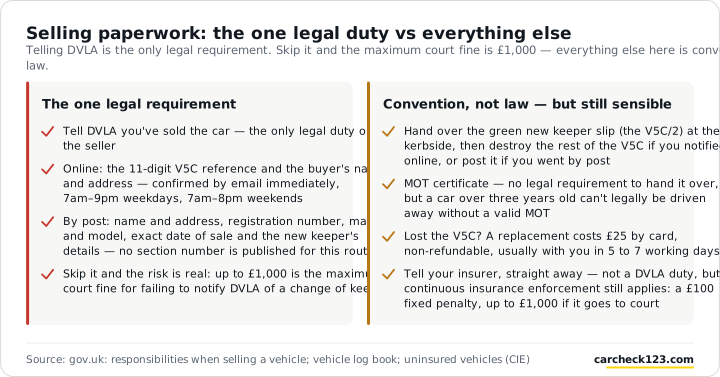
Sell a car in the UK and the law gives you one job: you have to tell DVLA you're no longer the keeper. That's the lot. The MOT certificate, the service history folder, a receipt, a "sold as seen" note: all useful, none of them a legal duty on the seller.
Part of our guide to selling your car.
There's a second legal point, but it applies to the car, not the sale. A car over three years old needs a valid MOT to be driven on a public road at all. That's a rule about driving, not about selling, so keep the two apart.
gov.uk states the duty plainly: "You must tell DVLA you've sold the vehicle and give them the full name and address of the buyer." Two routes:
- Online, the same day. You need the 11-digit document reference number from your V5C logbook and the buyer's full name and address. The service runs 7am to 9pm on weekdays, 7am to 8pm at weekends, and confirms by email immediately.
- By post, if you've already sent your logbook to DVLA or don't have one. Write with your name and address, the registration number, the make and model, the exact date of sale, and the new keeper's details.
The V5C logbook: what happens to it
This is where sellers get it wrong. The logbook doesn't simply change hands.
At the kerbside, fill in the green "new keeper" slip (the V5C/2) and hand over that, and only that. It's marked for the new keeper, and it lets them tax the car straight away.
Then deal with the rest one of two ways:
- Tell DVLA online. The instruction is blunt: destroy the V5C. Don't post it, don't file it, don't give it to the buyer. Their new logbook arrives within 5 to 7 working days.
- Post it instead. Fill in the section marked for notifying a change of keeper, sign the declarations, and send it to DVLA. The buyer's logbook usually arrives within 4 weeks.
Which section? It depends which style of logbook you have. On a new-style V5C, the one with multi-coloured numbered blocks on the front cover, gov.uk says to complete section 2. On the older style it's section 6, plus the declaration in section 8, which you and the buyer both sign.
Check that against the instructions printed on your own logbook.
What if you've lost the V5C?
You can still sell without one. But it costs you at the negotiating table because gov.uk advises buyers against buying a vehicle with no V5C.
If you still have the car, order a replacement first: £25 by card, non-refundable once used, and usually with you within 5 to 7 working days. You need the registration number, the VIN or chassis number, and the name and postcode on the existing V5C.
You can't use the online route in a few cases. Not if details need changing, and not if the vehicle is no longer in your possession. Not if you've already sent the V5C to DVLA, not if it's on DVLA's fleet scheme, and not if it's registered abroad. Abroad here includes the Channel Islands, Isle of Man and Ireland.
If you've already sold it without a logbook, don't wait for a replacement. Tell DVLA by post.
Do you need to tell your insurer?
Telling your insurer isn't a DVLA duty. But tell them. I'd do it the same day you hand over the keys.
Your motor policy is a private contract, not a DVLA process, and no gov.uk rule says you must notify your insurer when you sell. The practical reason is money. You're paying for cover on a car you no longer own. Cancelling or transferring it normally gets you a refund or a credit against the next car, depending on your policy terms.
There's also continuous insurance enforcement: while a vehicle is registered in your name and isn't declared off the road, it must be insured. gov.uk sets out a £100 fixed penalty for getting that wrong.
The penalty isn't the end of it. Clamping, impounding or destruction of the vehicle can follow, along with court prosecution and a fine of up to £1,000. Once DVLA records the sale, that obligation moves off you.
Does the buyer need your MOT certificate or service history?
Search this and you'll be told a valid MOT certificate is "required to complete the sale legally". You'll also read that service history is needed for a legal sale. Both are wrong, and wrong in the same way. They blur a rule about the car into a rule about the paperwork.
Start with the MOT: nothing requires you to hand over a certificate. The law requires the car to have a valid MOT if it's old enough to need one. And you can be fined up to £1,000 for driving a vehicle without one.
So it isn't a document problem. It's logistics. If the MOT has expired, your buyer can't legally drive the car away: they can trailer it, or take it straight to a pre-booked test.
The paper certificate barely matters now. Every MOT result for cars, motorcycles and vans since 2005 sits on DVSA's public record (DVSA is the agency that runs MOT tests). That covers pass or fail, the mileage at each test, the parts that failed and the advisories. Anyone with the registration number can download current and previous certificates from that record.
Then there's the service history. It isn't a legal handover requirement, but it's the evidence most likely to move the price. Hand over what you have.
That cuts both ways. Any buyer worth selling to will run a history check first. A report showing a write-off marker, a mileage discrepancy or a finance record you'd forgotten about isn't a conversation you want on your driveway.
A comprehensive check on your own car shows you what they'll see. A check is a snapshot, so it reflects the record when you run it. Run it close to the sale.
Outstanding finance is the one thing that can stop a sale outright. On hire purchase or PCP (personal contract purchase) the finance company owns the car until the agreement is settled. Until then you can't pass on clear ownership, so settle it before you advertise, and our guide to outstanding finance has the detail.
What happens to road tax and SORN
Neither travels with the car.
Start with road tax. Once you've told DVLA, gov.uk is clear: "your vehicle tax will be cancelled. You'll get a refund for any full months of remaining vehicle tax." It comes automatically by cheque.
Three things are never refunded: credit card fees, the 5% surcharge on some direct debit payments, and the 10% surcharge on a single 6-month payment. Our guide to car tax bands explains which applies to you.
The buyer gets nothing from your tax: they must tax the car themselves before driving it, and they can do that immediately with the green slip.
Then there's SORN, or Statutory Off Road Notification: the declaration that takes a car off the road without tax or insurance. It's automatically cancelled when you sell, and it can't be transferred.
The new keeper must tax the car or make their own SORN. Our SORN guide covers selling a car that's off the road.
What happens if you don't tell DVLA
One consequence should worry you more than any fine: you stay the registered keeper. As DVLA puts it, you're "legally responsible for the vehicle" until the sale is recorded and your details come off the vehicle record. Until then the speeding notices, parking charges, clean air zone penalties and tax obligations land on your doormat.
Sorting them out is a hassle, but possible. The process on gov.uk is to return the fine letter to whoever issued it, enclosing a copy of the letter DVLA sent you when you sold the vehicle. So keep that letter.
It's the one bit of paper I'd hang on to after the sale. Without it, write to DVLA with the registration number, the sale date and the buyer's details, and they'll send a replacement within 4 weeks.
Now, about that £1,000 fine. You'll see "up to £1,000" quoted everywhere, usually with no source. It isn't on gov.uk's page for telling DVLA you've sold a vehicle, which sets out no penalty at all. It does have a real statutory basis, just a narrower one than the way it's normally used.
Regulation 22 of the Road Vehicles (Registration and Licensing) Regulations 2002 requires notification of a change of keeper "forthwith". Regulation 47 and Schedule 8 turn that into a section 59(2)(a) offence under the Vehicle Excise and Registration Act 1994. That offence carries a fine not exceeding level 3 on the standard scale. Level 3 is £1,000 under section 122 of the Sentencing Act 2020.
So it's a maximum a magistrates' court could impose on conviction, not a penalty notice DVLA posts out for being a fortnight late. The real reason to notify on the day is liability, not the fine.
Then check it landed. Our free car check shows a car's current tax status alongside its full MOT record, from just the number plate. If tax still shows as running on a car you sold three weeks ago, something hasn't gone through.
FAQs
Do I need to tell DVLA I've sold my car?
Yes. It's the one legal paperwork duty the sale puts on you. Do it online with the 11-digit reference from your V5C, or by post if you don't have the logbook.
What happens if I don't tell DVLA I've sold my car?
You remain the registered keeper. Tax, parking and speeding notices and clean air zone charges stay your problem until DVLA records the change. There's also a maximum court fine of £1,000, a statutory maximum on conviction, not an automatic DVLA charge.
Can I sell a car without a V5C logbook?
Yes, but it'll cost you on price. gov.uk advises buyers against buying a vehicle with no V5C. If you still have the car, order a replacement first (£25, usually 5 to 7 working days). If you've already sold it, tell DVLA by post.
What part of the V5C do I keep when I sell my car?
None of it, in the end. The buyer gets the green "new keeper" slip (V5C/2). Notify DVLA online and gov.uk tells you to destroy the rest; notify by post and you send the logbook to DVLA.
Do I need an MOT to sell my car?
Not to sell it. But a car over three years old needs a valid MOT to be driven on a public road. Without one, your buyer can't legally drive it away. You don't have to hand over the paper certificate. The MOT record is public, and certificates can be downloaded from it.
Do I need to notify my insurance when I sell my car?
It isn't a DVLA requirement, but tell them. You'll usually be due a refund or a credit against a new car. And while a vehicle is registered to you and not declared off the road, it has to stay insured.