
How selling a car privately works
Selling privately usually puts more money in your pocket than a part-exchange or an instant-buy offer. You take on the work yourself.
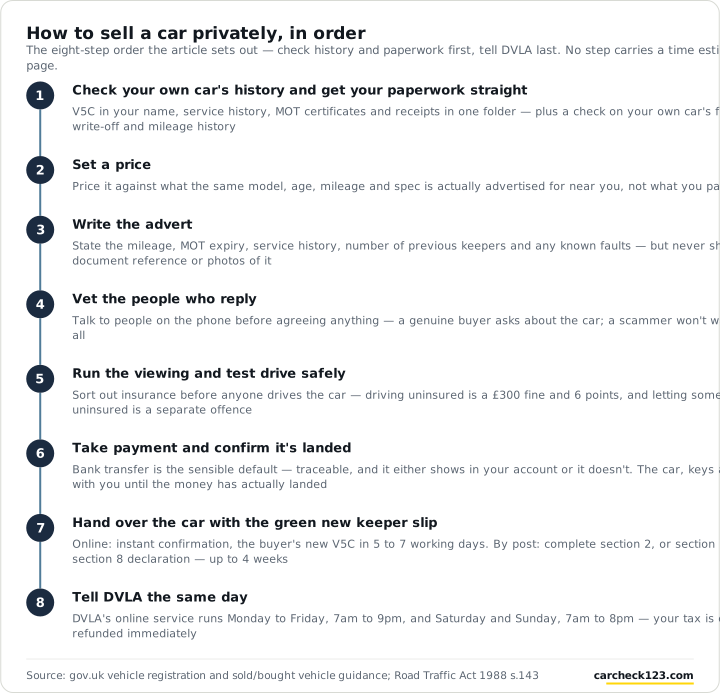
Follow this order. Check your own car's history first, and get the paperwork straight. Then set a price, write the advert, and vet the people who reply.
Handle the viewing and test drive safely, take payment, and confirm it's landed. Hand over the car with the green new keeper slip. Tell DVLA the same day.
Two things worry most private sellers, and both have clear answers. You're not on the hook for every fault that appears after the sale. Your obligations are nothing like a dealer's.
Most scams aimed at private sellers also fall apart under a single rule. Nothing leaves your hands until you've confirmed the money is in your account.
This is part of our wider guide to selling your car. Car doesn't run? Our guide to how to scrap a car covers the other routes.
Before you list: paperwork, price and a check on your own car
Get these in order before the advert goes live. Not while a buyer's standing on your drive.
- The V5C logbook, in your name, with your current address. GOV.UK says to apply to update your log book before you sell if you have changed name or address, or modified the car, because "you may not get a refund for any full months left on your vehicle tax if your details are incorrect".
- A replacement V5C if yours is missing. A replacement log book costs £25, is non-refundable and usually arrives within 5 to 7 working days. Start it before you advertise, because you can't use DVLA's online sale service without a V5C.
- Service history, MOT certificates and receipts in one folder. A buyer who can see the paper trail argues less about price.
- Your private plate removed, if you want to keep a personalised registration. GOV.UK says you must apply to remove it before you sell. Our guide to keeping your private plate when you sell covers the order to do it in.
Then price the car against what the same model, age, mileage and spec is advertised for near you. Not against what you paid.
The last job is the one most sellers skip. Run a history check on your own car. You could be carrying outstanding finance from a previous keeper, an old write-off marker or a mileage discrepancy without knowing it.
The buyer's check will find it at the worst possible moment. Find it first and you can settle it, price for it, or describe it honestly. A clean report takes a lot of haggling out of the room.
A Comprehensive check covers finance, write-off and stolen markers, mileage and the full MOT record. The sample report shows you the format. A report shows the car as it stands when you run it, so run a fresh one before handover if the sale drags on.
Writing the advert and vetting buyers
Write the advert accurately. The description is one of the few places a private seller can create real legal liability.
Photograph the car in daylight from every angle. Include the interior, the tyres and any damage you're disclosing. State the mileage, MOT expiry, service history, number of previous keepers and any known faults.
One thing to leave out: the logbook. GOV.UK warns you explicitly not to share your log book document reference number, or pictures or copies of your log book. Someone could use those to "get a fraudulent copy of your log book, putting your vehicle at risk of being stolen or cloned".
Showing a buyer the V5C in person is fine. Emailing a photo to a stranger isn't.
Talk to people on the phone before you agree to anything. A genuine buyer asks about the car. A time-waster won't commit to an appointment. A scammer won't want to see it at all.
The viewing and test drive
Arrange viewings in daylight, and have someone else at home with you. Take their name and address when you book the appointment. Keep your own keys in your pocket until the car is sold.
Before anyone drives your car, sort out insurance. It isn't enough that the car is insured, because the driver has to be insured to drive it.
Section 143 of the Road Traffic Act 1988 covers this. It's an offence to "cause or permit any other person to use a motor vehicle on a road or other public place" without insurance in force for that person's use of it. That makes it your problem too.
That leaves three options. The buyer's "driving other cars" cover might extend to your car. Many policies don't offer it, though, and where it exists it's often third-party-only and age-restricted. Ask them to check with their insurer rather than assume.
The other two routes are temporary cover bought for the drive, or your own policy if it covers other drivers.
Ask to see the proof, check their licence against the name on it, photograph both, and go with them.
Private-sale scams to watch for
Fake payment confirmations. Action Fraud has documented fraudulent emails in online car sales claiming to come from "Amazon Payments" or "Amazon Flexible Payment Services". They pose as escrow accounts that hold money for a week before releasing it. No such account exists.
That case targeted buyers. The same trick works on sellers: a convincing email, text or screenshot saying the money is "held", "released" or "on its way". Only your own banking app counts.
Your advert being cloned. In a case flagged by Action Fraud, a genuine seller's advert photos were copied into a fake advert at a non-existent address. The fraudsters demanded payment up front, before the car could be viewed.
As the genuine advertiser, you may never hear about it. Or you only find out when a confused buyer gets in touch about a "sale" you never made.
The buyer who never wants to see the car. This is the one who's abroad, who will "send a courier", or who offers a deposit sight unseen. Genuine buyers come and look at the car. Treat anything else as a scam until proved otherwise.
Overpayment is a long-running scam against sellers of high-value items. A cheque or banker's draft arrives for more than you agreed, with a plausible reason attached. Then comes a request to wire back the excess, before the paper has cleared. Never send money back on an overpayment, and don't accept one in the first place.
Taking payment safely
MoneyHelper is the government-backed money guidance service. It puts the choice plainly: if you're selling goods or services, it's better to use an instant payment method such as bank transfer.
- Bank transfer is the sensible default. It's traceable, and it either shows in your account or it doesn't. Expect the buyer's daily payment limit to bite on a car of any value, so agree in advance how they'll handle it. "It's sent, it's just pending" is not the money arriving.
- Cash is instant, but it brings its own problems: counting it, checking it isn't counterfeit, then walking around with it. Do the handover at a bank branch and pay it straight in.
- Cheques clear slowly and can bounce. MoneyHelper says one paid in before the bank's cut-off (often around 3pm) should be available by the end of the next working day, with a Post Office deposit adding another. Accept one only from someone you trust; a car buyer is usually a stranger.
- Banker's drafts are misunderstood. MoneyHelper's point is that a draft can't bounce, because the bank takes the funds when it writes it, but it's still paper that "could be lost, stolen or tampered with". The risk is forgery, not bouncing. Check any draft with the issuing bank before the car moves.
Handing over the car, the V5C and telling DVLA
How you handle the logbook depends on how you notify DVLA. GOV.UK sets out both routes for a used car staying in the UK:
- Online, which is the sensible option. Register the vehicle to the buyer, fill in the green "new keeper" slip and give it to them, then destroy the rest of the V5C. You get instant confirmation, and their new V5C arrives within 5 to 7 working days.
- By post. Complete section 2 (new-style V5C) or section 6 plus the section 8 declaration (older style), give the buyer the green slip, and post the V5C to DVLA. Their new V5C takes up to 4 weeks.
DVLA's online service is open Monday to Friday, 7am to 9pm, and Saturday and Sunday, 7am to 8pm. Once you've told them, your vehicle tax is cancelled and you're refunded for any full months remaining.
Can't use it because you've already posted the V5C or never had one? Write to DVLA at Swansea, SA99 1BA instead. Include your name and address, the registration number, the make and model, the exact date of sale and the buyer's full name and address.
Tell the buyer they can't drive away on your tax. It isn't transferred with the vehicle, so they need to tax the car or declare it off the road first, using the green slip.
Then write a receipt: two copies, signed, with the date, price, registration, mileage and both parties' names and addresses. That's your evidence of when responsibility passed.
Tell your insurer too. There's no point paying for cover on a car you no longer own. Our guides to the paperwork when selling and what to check on a V5C go further into the documents.
Are you liable if something goes wrong after the sale?
Far less than you fear, but not nothing.
The Consumer Rights Act 2015 gives used-car buyers a right to satisfactory quality and a 30-day right to reject. It applies only to contracts between a trader and a consumer. Section 2 defines a trader as "a person acting for purposes relating to that person's trade, business, craft or profession". Selling your own car isn't that, so none of it applies to you.
What's left is the Sale of Goods Act 1979, which draws the line just as clearly. Section 14 says "there is no implied term about the quality or fitness for any particular purpose of goods supplied under a contract of sale", except as that section provides.
Its satisfactory-quality duty only bites "where the seller sells goods in the course of a business". A private seller doesn't owe it, so if the clutch goes a fortnight later, that's the buyer's problem.
Two duties do still apply to you:
- The car must match its description. Section 13 implies a term that goods sold by description "will correspond with the description". If your advert says full service history, or one previous owner, or 78,000 miles, that has to be true.
- You must not lie. Under section 2(1) of the Misrepresentation Act 1967, a false statement that induces someone into the contract and causes them loss can make you liable in damages. The exception is where you had reasonable grounds to believe, and did believe, that it was true.
In plain terms, you don't have to volunteer every squeak and stone chip. You do have to answer direct questions honestly and describe the car accurately. "Never been in an accident" and "full service history" are claims, not sales patter.
That's the practical reason to check your own car before you advertise it. It's easy to describe a car as clean when it carries outstanding finance or an insurance write-off marker you never knew about. You'd still be the one arguing about it afterwards.
If your situation is unusual, check with Citizens Advice or GOV.UK rather than relying on a guide like this one.
Common questions
Is it safe to accept a bank transfer for a car?
Yes. MoneyHelper recommends it for selling goods, because it's instant and traceable. Check it in your own banking app, not in an email, text or screenshot the buyer shows you. And agree beforehand how they'll handle their daily transfer limit.
Do I need to be present when a buyer test drives my car?
Yes, and check they're insured first, through their own "driving other cars" cover, temporary cover, or your policy if it covers other drivers. Permitting an uninsured drive is an offence under Section 143 of the Road Traffic Act 1988. That makes it your liability too.
What do I do if a cheque bounces after I've handed over the car?
Contact your bank straight away, and report it to Action Fraud on 0300 123 2040. Recovering the car or the money then becomes a civil matter, and often a difficult one. That's why the real answer is simple: don't release the car for a cheque at all.
How do I tell DVLA I've sold my car, and what happens to my road tax?
Use DVLA's online service for instant confirmation. Your tax is cancelled, and you're refunded for any full months remaining. No V5C, or already posted it? Write to DVLA at Swansea, SA99 1BA instead.
Am I liable if the car breaks down after I've sold it privately?
Generally, no. The Consumer Rights Act 2015 only covers trader sales. The Sale of Goods Act 1979 implies no quality or fitness duty unless you sold in the course of a business. You can still be liable if the car didn't match your description (section 13). The same goes if you made a false statement that persuaded the buyer (Misrepresentation Act 1967, section 2(1)).
What documents do I legally need to sell a car privately in the UK?
The V5C logbook, in your name and with correct details. The buyer gets the green "new keeper" slip from it. Service history, MOT certificates and receipts aren't legally required. But they're worth real money at the negotiating table.