
What number plate cloning is (and isn't)
Number plate cloning means a criminal copies a legitimate registration. They fit it to a different car with the same make, model and colour. The second car now wears the identity of someone else's vehicle. It looks convincing enough at a glance or to an automatic number plate recognition (ANPR) camera.
If you're viewing a car, it could be either one: the original or the copy.
The point isn't to steal that car. It's to borrow its clean identity, so speeding tickets, ULEZ charges and parking fines land on someone else entirely.
If you buy a car wearing a cloned plate, you can end up dealing with fines for places you've never driven. The same happens if a criminal clones your plate after you've bought the car.
That's a different problem from car theft, covered in our guide to stolen car checks. It's different again from mileage clocking, which tampers with a genuine car's own odometer rather than its identity.
Not every plate change is suspicious. Private registrations, DVLA-issued keeper or address updates, and straightforward V5C reissues are all normal. They're legitimate reasons for a plate's paperwork to look "recent". The V5C is the car's registration certificate, sometimes called the logbook, and our guide to V5C logbook checks covers how that document actually works.
A recent V5C date alone proves nothing either way. It's one clue among several.
This article is part of our guide to car history checks.
How common is it right now
Plate cloning is a growing problem. Good, dated figures are harder to find than the coverage suggests. Much of what's shared online repeats old numbers as if they were current.
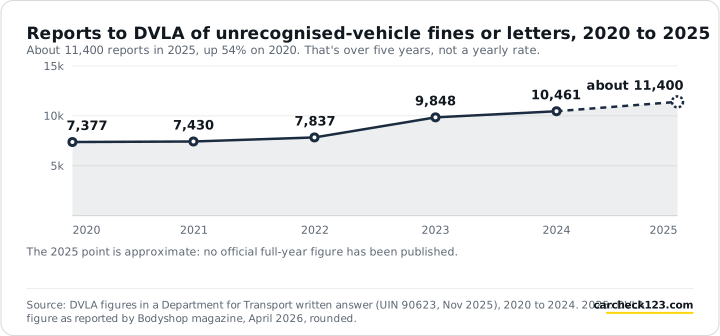
The clearest figures are DVLA's, published up to 2024 by the Department for Transport, and the press reported the 2025 total in 2026. Reports to DVLA of fines or letters for vehicles people didn't recognise rose from 7,377 in 2020 to 10,461 in 2024, then to about 11,400 in 2025. That's roughly a 9% year-on-year rise for 2025. Across the full five-year span, it's a 54% increase.
Between those dates, there were 7,430 reports in 2021, 7,837 in 2022 and 9,848 in 2023.
Not all of those reports involve cloning. The Department for Transport says cloning is only one possible reason, and some are errors, such as a registration typed in wrong.
Treat the 54% as a multi-year trend, not an annual rate. A lot of secondary coverage collapses it into a misleading "year-on-year" framing.
There's a separate figure for London too. A BBC investigation used a Freedom of Information request to look at penalty charge notices (PCNs) cancelled by London councils because the vehicle was cloned. Those rose from 22,450 in 2021 to 36,794 in 2023, a 64% increase.
That measures PCN cancellations, not DVLA reports. Don't add the two series together.
One older figure still gets quoted. Transport for London found that ULEZ-related PCN cancellations linked to cloning rose 857% comparing April 2021 to April 2022. It's a genuine, sourced number, but it's several years old now and shouldn't be read as a current rate.
What's being done about cloned plates
Enforcement is catching up. On 5 September 2026 the Department for Transport announced funding for a new police unit, the National Roads Policing Coordination Centre. The DfT says it will bring police forces from around England together to share intelligence and make better use of data on illegal plates. The announcement gives no funding figure and no date for when the unit starts work.
The DfT says the unit will target organised crime as well as drivers dodging speeding, parking and clean air zone penalties. It also says the unit will trial new technology, giving the example of specialised goggles that can detect plates criminals have tried to make unreadable to cameras. The DfT calls that a trial. BBC Panorama filmed a roadside check by police and DVLA where infrared goggles showed a van was carrying a ghost plate.
The announcement lists cloned plates, missing plates and "ghost plates" (a transparent film that makes a registration undetectable to cameras) as examples of illegal plates. Ghost plates are a way of dodging cameras. They look like normal plates to the naked eye, the BBC reports, so you may not spot one at a viewing. This guide focuses on cloning, which is on the new unit's list.
Our guide to ghost number plates covers what test cameras are finding and the fine for driving with one.
None of this changes what you check at a viewing. This should mean a cloned plate gets picked up sooner once it's in use, which is good news if yours is the identity being borrowed. The DfT also says DVSA and DVLA are supporting investigations into businesses that supply illegal plates. Keep that in mind when you check who made the plates on a car you're viewing.
One rule the announcement repeats is about display, not cloning: drive with incorrectly displayed plates and you can be fined up to £1,000. DVLA's rules add that the car fails its MOT, and that a plate must be marked to show who supplied it. That is a penalty for how a plate is presented, not for unknowingly buying a car whose identity someone else has copied. It's another reason to ask about missing supplier markings before you buy rather than after.
The red flags to check at the viewing
A cloned car looks and drives normally. Cloning changes the paperwork trail, not the vehicle itself. So cross-check the documents and identifiers instead of looking for something visibly wrong.
- Check the VIN in two places and match it to the V5C. Every car has a Vehicle Identification Number stamped in at least two places: typically on a plate visible through the base of the windscreen on the driver's side, and stamped into the driver's door frame or sill. Both should match the number printed on the V5C logbook. Any mismatch, or a VIN plate that looks re-riveted or tampered with, is a reason to stop and ask questions rather than talk yourself past it.
- Look at the plates themselves. Legally fitted number plates carry the supplier's name and postcode. Plates that look newly fitted, don't match each other's font or style, or are missing supplier markings are worth asking about. Legitimate replacements happen, but the seller should be able to show you a paper trail: a receipt or the supplier's details.
- Check the V5C issue date against the car's actual age and history. A very recent V5C on an older car isn't proof of anything by itself. Paired with other flags, though, it's worth asking why.
- Watch how the seller behaves. A genuine private seller can usually meet you at the address on the V5C. Refusing to meet there, insisting on somewhere neutral instead, pushing for a same-day cash sale, or a price that's noticeably under market are all classic pressure tactics. None of that proves cloning by itself. But that combination makes it easier for a cloned or otherwise problematic car to slip through unchecked.
Checking a plate's change history before you view the car
Our free car check confirms the basics from just the registration: make, model, current tax status and full MOT history. So you can catch an obvious mismatch against the make and model DVLA has on file before you leave the house. You don't need a separate government lookup. Colour and plate-change history are included in the paid checks.
Our Comprehensive check goes further. It includes the vehicle's plate-change and previous-keeper history alongside outstanding finance, insurance write-off markers and stolen-vehicle flags. It's the closest you'll get to a direct answer to "has this identity been swapped onto a different car?" See what one looks like in this sample report.
No check can prove a plate is or isn't cloned with total certainty. Cloning is designed to look clean on paper. But a plate-change record that doesn't match the seller's account is where I'd walk away.
Not every plate change is the seller's doing. DVLA has its own powers to hold a registration back or take one off a car. Our guide to banned number plates explains when it uses them.
What happens if you unknowingly buy a cloned-plate car
The practical fallout usually isn't about the car itself. Not its roadworthiness, not its value. It's fines and correspondence tied to the plate. That plate may have been used elsewhere, before or after you bought the car, for offences that have nothing to do with you.
Sorting it out means proving that the plate's history doesn't match your ownership of the car. You prove it to the DVLA, the police and whichever authority issued a fine.
It's a separate risk from outstanding finance, which follows the car itself rather than its plate. A plate-change check doesn't cover it. See our guide to outstanding finance for that one.
Is my own car's plate cloned?
Fines, ULEZ or Clean Air Zone charge notices, or parking tickets for places you've never driven are the classic sign. Your own plate has probably been cloned onto someone else's car. That doesn't mean your check history is wrong.
Report it to the police first. In England and Wales, use the cloned number plates form on the police website or call 101, as gov.uk sets out. In Scotland or Northern Ireland, call 101. Either way, you'll be given a report reference number.
If you used the form, the police tell DVLA for you. If not, write to DVLA with your registration number and copies of the fines, and it will send a confirmation letter to the address on your V5C.
Then contact whoever issued the fine. Say you've reported the cloned plates to the police and DVLA, and ask them to cancel it. If you wrote to DVLA, include a copy of its confirmation letter.
Keep records of everything. You may need to go through this more than once if the same clone is used repeatedly.
If the plate itself was taken off your car, the route is different. Our guide to what to do if your number plate is stolen covers it.
FAQs
What is number plate cloning?
It's when a criminal copies a legitimate UK registration plate and fits it to a different car with the same make, model and colour. Fines and camera-detected offences then land on the plate's real, innocent owner instead of the criminal.
How do I know if a used car's plate has been cloned?
There's no single foolproof test. Check that the VIN in the windscreen and door sill matches the V5C. Look for mismatched or freshly fitted plates. Be wary of a seller who won't meet at their registered address. A Comprehensive check adds the car's plate-change and previous-keeper history to cross-reference against what you've been told.
Is it illegal to unknowingly drive a car with a cloned plate?
Cloning itself is a crime committed against you, the innocent keeper. You haven't broken the law by unknowingly buying or driving a car that's had its identity swapped. The practical problem is proving it to whoever issued a fine tied to the plate.
Can a car history check spot a cloned number plate?
A history check can't prove a plate is cloned with certainty, because cloning is designed to look clean on paper. It can show the plate's change and keeper history, which you can then cross-reference against the seller's account. A mismatch there is a strong warning sign.
What do I do if I get a fine for something I didn't do because my plate's been cloned?
Report it to the police, using the online form in England and Wales or by calling 101, and keep the report reference number. If you didn't use the form, tell DVLA by post. Then appeal to whoever issued the fine, saying you've reported it to the police and DVLA. If you wrote to DVLA, include a copy of its confirmation letter.
Does a recent V5C or plate change always mean something's wrong?
No. Buying a private plate is normal. So are keeper or address updates and straightforward V5C reissues. None of them indicate cloning on their own. Treat a recent change as one factor to weigh alongside the other checks, not a red flag by itself.