
How the MOT test is structured
A car needs its first MOT by the third anniversary of its registration, then every year after that. Some vehicles are exempt, most notably certain historic vehicles over 40 years old. For an ordinary used car, assume an annual test applies.
A Class 4 vehicle is an ordinary car with up to eight passenger seats. The maximum fee a garage can charge to test one is £54.85. That's a cap, not a fixed price, so many garages charge less. Our guide to the MOT fee cap covers the push to raise it.
On the day, the tester grades each fault they find. Since 20 May 2018, defects have fallen into three categories. Dangerous and Major both fail the car. Minor is a pass, but it goes on the record.
Advisories are separate from those categories. An advisory notes that a part is wearing but isn't bad enough to fail yet. We cover how to read those in MOT Advisories Explained. It's worth a look if you're staring at a car's history and trying to tell a red flag from ordinary wear.
Part of our guide to MOT, road tax and staying legal.
The full MOT checklist, category by category
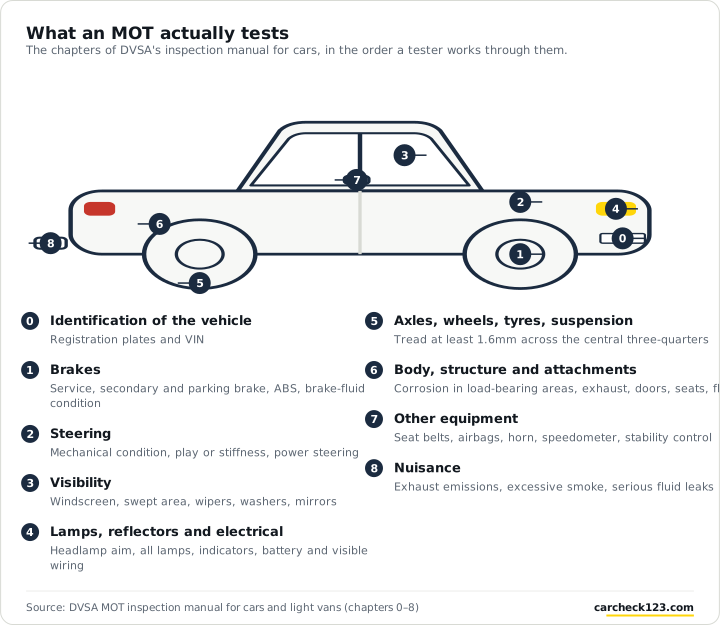
These are the chapters of DVSA's MOT inspection manual for cars and light vans, in order. A tester works through them all. This checklist follows DVSA's own chapter structure rather than an invented one, so you can cross-check any car against the primary source. Every competitor checklist we found reshuffles the test into its own headings, which makes that impossible.
Identification of the vehicle
Before the test starts, the tester checks that the car is the one on the paperwork. That means checking the registration plates: present, secure, correctly spaced and legible. It also means checking the vehicle identification number (VIN). A missing or unreadable plate, or a VIN that can't be found, stops the test.
1. Brakes
The big one. The tester checks the condition of the brake components first. Then they measure how well the service brake (the pedal), the secondary brake and the parking brake actually work, on a roller brake tester or by other approved means. Anti-lock braking (ABS) and electronic braking (EBS) warning systems are checked too, along with brake fluid condition.
2. Steering
The tester checks the mechanical condition of the steering system, the steering wheel and the column. They look for excessive play or stiffness. Where electronic power steering is fitted, it's checked too, including its warning lamp.
3. Visibility
The tester checks the driver's view of the road: windscreen condition, anything obstructing the swept area, the wipers and washers, and the mirrors (or other means of seeing behind). Damage directly in the driver's line of sight is judged more harshly than a chip out at the edge.
4. Lamps, reflectors and electrical equipment
Headlamps (including aim), position lamps, daytime running lamps, brake lamps, indicators, hazards, fog lamps, reversing lamps, reflectors and the security and condition of the battery and visible wiring.
If you've fitted LED bulbs to halogen headlamps, read the MOT rule for them from 14 October 2026.
5. Axles, wheels, tyres and suspension
Axles, wheel bearings, the wheels themselves, the suspension and the tyres. This is where the most-searched MOT fact of all lives.
A tyre worn below that fails. So does one with certain damage or the wrong size or type. Tyre pressure monitoring (TPMS) warning systems are checked on cars first used from 2012.
6. Body, structure and attachments
The car's structural integrity: corrosion or damage to load-bearing areas and anywhere near brake or steering mountings. They also look at the general condition of the body, the exhaust system (secure and complete), the doors, seat security and the floor.
7. Other equipment
Every fitted seat belt is checked for condition, security and operation. The tester then checks airbags and other supplementary restraint systems, the horn, the speedometer and electronic stability control where fitted.
8. Nuisance
For emissions and noise, the tester runs an exhaust emissions check appropriate to the engine and fuel type. They also look for excessive smoke, check the engine malfunction (management) warning lamp, and note any serious fluid leaks. This is the environmental half of "road safety and environmental standards".
(DVSA's manual has two further chapters. Chapter 9 covers supplementary tests for buses and coaches, and chapter 10 covers seat-belt installation checks for older vehicles not built with belts. Neither applies to the ordinary car, so neither appears above. Both are still part of the full ten-chapter structure.)
What an MOT does NOT check
Plenty of buyers get this wrong: an MOT isn't a service or a mechanical health check. gov.uk states plainly that "the test does not cover the condition of the engine, clutch or gearbox."
Nothing outside the chapters above is inspected. Cambelt condition, oil quality, clutch and gearbox condition, and internal engine wear are all invisible to the test.
It doesn't check service history either. It won't tell you whether the car has been written off, clocked, or has finance owing on it. What commonly fails, and how to spot the patterns, is covered in Common MOT Failures.
What's new or changing in 2026
The "new MOT rules 2026" headlines need splitting in two. gov.uk confirms some of them, but not the rest.
Confirmed: tighter tester-ban enforcement (9 January 2026)
MOT Special Notice 05-25 was published on 19 December 2025. From 9 January 2026, a tester or authorised examiner principal given a two-year or five-year disciplinary "cessation" is barred from holding any MOT role for the whole of that period. This is about who can test, not what's tested. It's an integrity measure, and a reminder that a historic test is only as reliable as the person who signed it.
Confirmed: jacking-equipment specification change (1 April 2026)
MOT Special Notice 04-25 brings in new jacking-equipment specifications for Class 4 test bays from 1 April 2026. It applies only to centres applying to open or change from that date. The old spec couldn't safely jack some heavier electric and hybrid cars. It's a garage-equipment standard, not a new check on your car.
If your usual test station is already set up, nothing changes for you.
Under review: "new EV checks" and "digital tyre gauges"
Some 2026 coverage claims DVSA has brought in new EV-specific high-voltage inspections (cables, charging port, battery) and mandatory digital tyre tread gauges. On gov.uk's own published record, neither claim stands up as a new-for-2026 rule.
DVSA's inspection-manual updates log shows no new EV inspection item added in 2025 or 2026. Testing electric and hybrid vehicles is long-standing guidance. The only recent EV-related change is a wording clarification about tester safety around high-voltage cabling, not a new check on the car.
There's no gov.uk source mandating digital tyre gauges either. Digital gauges are just one type of DVSA-approved tool a garage may already use, not a 2026 requirement. Seen these claims elsewhere? Treat them as unconfirmed until DVSA's own updates say otherwise.
How to check a car's MOT history before you buy
You don't need gov.uk's checker for this. Our own free car check pulls a car's full MOT record using just the number plate, alongside its current tax status. For each test, it shows the date, the pass or fail result, the mileage recorded, any failure reasons and any advisories.
The useful part is reading them together over several years. Watch the mileage above all. It should only ever climb. Run the plate through our MOT check tool while you're comparing cars, and let the record shape the questions you ask and the price you offer.
FAQs
What is checked in an MOT test?
Brakes, steering, visibility, lights and electrics, axles/wheels/tyres/suspension, the body and structure, seat belts and other equipment, and emissions and noise. Those are the eight core chapters of DVSA's inspection manual. A vehicle identity check comes first.
What does an MOT not check?
General mechanical condition and servicing. gov.uk states the test does not cover the engine, clutch or gearbox, and it checks nothing outside its safety and emissions remit. A pass is not a guarantee the car is healthy or well-maintained.
What's the difference between an MOT advisory and a fail?
A car fails on a Dangerous or Major defect. An advisory isn't a fail. It's a note that something is wearing but was acceptable on the day. See MOT Advisories Explained.
How much does an MOT cost in 2026?
The maximum fee for a car (Class 4) is £54.85. That's a cap, and many garages charge less.
Is the MOT test changing in 2026?
Two confirmed changes affect who tests and how garages are equipped: tester-ban enforcement from 9 January, and jacking specs for new or changing centres from 1 April. Neither changes what's checked on your car. Claims of new EV-specific checks or mandatory digital tyre gauges aren't confirmed on gov.uk.
Does the MOT emissions check mean my car is ULEZ compliant?
No, they're different things. The MOT checks your car's actual exhaust emissions against a standard for its type. ULEZ and Clean Air Zone compliance is about the car's emissions class and whether a daily charge applies. See ULEZ and Clean Air Zones, or check a specific car with our ULEZ check.