
What 'full service history' actually means
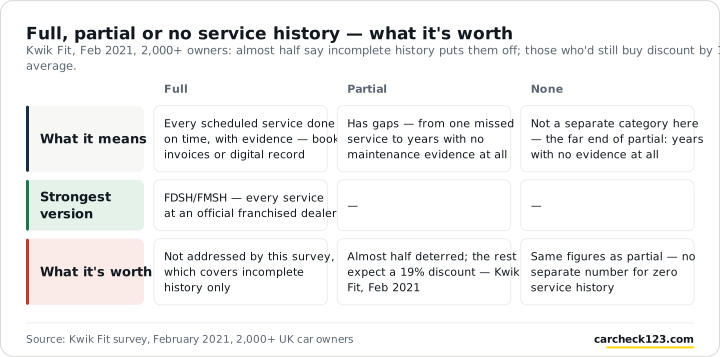
A full service history means every service the maker's schedule called for actually happened. On time, with evidence to prove it. That evidence can be a stamped book, invoices, or a digital record.
It doesn't have to be main-dealer servicing. And there's no official government check for it, the way there is for MOT and tax, so a seller's word is a starting point, not the answer.
What counts as a 'full service history'?
"Full" means servicing done in line with the manufacturer's recommended schedule, for the car's whole life, or since the current run of ownership records began. It also means evidence you can actually see: a stamped service book, itemised invoices, or a digital service record. The evidence is what matters. A seller's claim is worth far less than evidence you can see.
Full service history vs part service history — what's the difference
A part, or partial, service history has gaps: a missed interval, a late service, or paperwork that's gone missing along the way. Not all gaps are equal. One missed service on an otherwise complete record is generally lower risk than years-long gaps with no evidence of any maintenance at all.
So ask specifically what's missing and why, rather than treating "part service history" as a single category of risk. A single skipped service wouldn't put me off a car I otherwise liked, but years of silence would.
Does it have to be a main dealer?
Full dealer/manufacturer service history (FDSH/FMSH) vs full service history generally
FDSH or FMSH means every service happened at an official franchised dealership. That's a narrower, stronger claim than "full service history" on its own. A car can have a genuinely full history without ever visiting a main dealer.
Why independent-garage servicing still counts
A car serviced at a good independent garage still counts as having a full service history. That's true provided the work followed the manufacturer's schedule and used parts of matching quality.
That's trade practice, not law. The law that does exist here is about your warranty, and it isn't quite the law you'll read about elsewhere. The Motor Vehicle Agreements Block Exemption Order came into force on 1 June 2023, replacing the retained EU regulation. It runs to the end of 31 May 2029.
What that Order protects is access. Spare parts, tools, technical information and training, for the garages outside a maker's own network. It never mentions warranties at all.
The warranty point comes from somewhere else. The Competition and Markets Authority publishes guidance on motor vehicle agreements, and paragraph 5.36 is the one that matters. A warranty made conditional on your ordinary, non-warranty servicing happening only inside the maker's network may be caught by the Chapter I prohibition. That's the Competition Act 1998's ban on anti-competitive agreements.
That "may" is doing real work. It's guidance on how the regulator applies that ban, not a statute promising your warranty survives. And the maker keeps one right either way. It can refuse a claim where the fault is causally linked to a repairer's bad work, or to a third-party part that failed.
So the schedule, the right parts and the paperwork still matter. Our guide to main dealer servicing and your warranty covers the conditions in full.
That applies during the manufacturer's warranty period. Our guide to used car warranty options covers how warranty cover generally works on a used car.
Paper service book vs digital service records
The stamped paper booklet is on the way out. It's being replaced, or added to, by digital service records the manufacturer holds. Servicing gets logged digitally against the car's VIN and pulled up through the manufacturer's own systems, either instead of or alongside a physical stamp. Many makers offer this now.
Digital records instead of a stamped book aren't a red flag by themselves. Ask which manufacturer system holds the record, and whether the seller can show you access to it. Treat it exactly as you'd treat a paper book.
There's no official government check for service history
You can check MOT status and road tax instantly from a registration plate. Our own free car check shows both. Service history is different: there's no gov.uk, DVLA or DVSA service that checks it, as there is for MOT and tax. It simply isn't information the government holds centrally, so don't waste time looking for a check that doesn't exist.
How to check a used car's service history before you buy
There are four checks worth making.
- Ask to see the actual book or invoices, not just a verbal claim. A seller who can't show you the evidence or gets evasive when asked is telling you something.
- Contact the dealer or manufacturer directly with the VIN. Many can confirm whether their own records show a service history for that specific car, independent of what the seller shows you.
- Consider a paid manufacturer-record lookup for extra peace of mind on a specific car if that manufacturer offers one.
- Cross-check the mileage. Our free car check shows the mileage recorded at every MOT test, so compare that against the mileages in the claimed service record. If they don't line up, that's a concrete, checkable mismatch worth raising before you buy. The check doesn't show the service records themselves, only the MOT mileages.
What if a car has part service history, or none at all?
It isn't automatically a dealbreaker. Weigh the car's age, how long the gaps actually are, and what else you can find out about its condition. A Comprehensive check verifies the car's finance, write-off and mileage history, which fills in part of the picture.
It doesn't confirm servicing either, though. A patchy service record on an older car is something to factor into your offer, or a reason to walk away. No paid check makes that call for you.
How much is a full service history actually worth?
A Kwik Fit survey from February 2021 asked 2,000+ UK car owners about this. Almost half said an incomplete service history would put them off buying. Those who'd still consider it expected an average 19% discount to compensate. That figure is several years old now, so treat it as a general indicator of buyer sentiment rather than a current, precise number.
Resale value isn't the whole story. A patchy service record is an early sign of maintenance being put off, and maintenance put off tends to show up as higher running costs sooner rather than later. Once you've settled on a specific car, our free check's running-costs estimator is worth using for fuel, road tax and the MOT test fee. The estimate doesn't include servicing or repairs, so budget for those separately.
Service history is also one of the named factors in resale value. Our guide to car depreciation covers how it fits into the wider picture. It's one strand of what a used car costs you. Our ownership guide covers the others.
FAQs
What's the difference between full and part service history?
Full means every service the manufacturer's schedule called for happened. On time, with evidence. Part means there are gaps. That covers anything from one missed service to years without any record. So ask specifically what is missing. Don't treat all "part" histories the same.
Does full service history have to mean a main dealer?
No. Servicing at a good independent garage still counts. It has to follow the manufacturer's schedule, and use parts of equivalent quality. It shouldn't cost you the manufacturer's warranty either. The CMA's guidance says a warranty that ties your own paid-for servicing to the maker's network may be caught by competition law. That's guidance rather than statute, and a maker can still refuse a claim where bad work caused the fault. Keep the invoices either way. Our guide to main dealer servicing and your warranty has the detail.
What is FDSH or FMSH?
Full dealer or manufacturer service history. It means every service was carried out at an official franchised dealership. That is a narrower, stronger claim than "full service history" on its own.
Can I check a car's service history online for free, like I can with MOT history?
No. Our free check confirms MOT and tax instantly from a registration. But there is no government check for service history. You have three options. Ask to see the evidence directly. Contact the manufacturer or dealer with the VIN. Or pay for a manufacturer-record lookup, where one exists.
Is it worth buying a car with part service history, or no service history?
It isn't automatically a dealbreaker. Weigh the car's age, and how long the gaps actually are. It's a reason for a lower offer, or for extra caution. It isn't necessarily a reason to walk away.
How much is full service history actually worth when buying or selling?
A 2021 Kwik Fit survey found buyers without a full history expected around a 19% discount on average. Treat that as a rough, dated indicator of buyer sentiment rather than a precise current figure. It matters as much for what it signals about likely future running costs as for resale value.