
What it costs to run a used car in the UK — the full picture
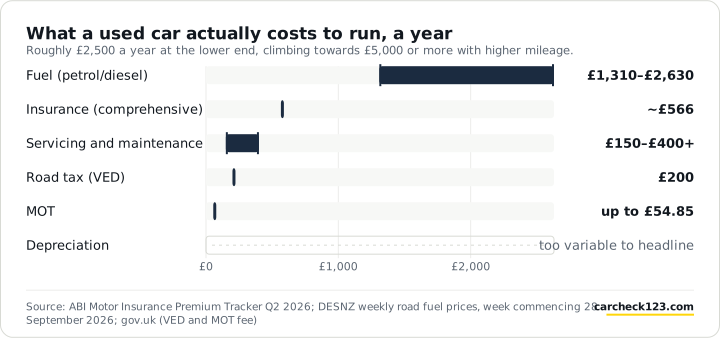
Running an ordinary used petrol or diesel car in the UK costs roughly £2,500 a year at the lower end. That's low mileage in a cheap-to-insure car. It climbs towards £5,000 or more with higher mileage, pricier insurance, or a car that needs more work.
There's a reason the range is so wide. Insurance, fuel, tax, MOT and servicing all move independently. Some vary more than others.
There's no neat headline figure for a single car. No published "cost of motoring" index gives one any more, and the well-known numbers quoted elsewhere either haven't been updated in years or come from pages that no longer exist.
The nearest published benchmark is the ONS Family Spending survey. For the year to March 2025 it puts average household spending at £33.70 a week on running personal transport, and £37.70 a week on buying vehicles.
Check the small print, though. Those figures are per household, not per car, and they're averaged across households that own no car at all.
The running figure is built from four things: fuel and motor oils, repairs and servicing, spares and accessories, and other motoring costs such as parking and breakdown cover. Nothing in it stands for depreciation. Vehicle insurance and road tax are counted, but under separate headings of their own.
The total here is built from its parts, with each cost checked against a named, dated source. The list covers insurance, fuel, tax, MOT, servicing, depreciation and warranty.
| Cost | Typical range | Source |
|---|---|---|
| Insurance (comprehensive) | ~£566 a year on average | ABI, Q2 2026 |
| Fuel (petrol/diesel) | roughly £1,310–£2,630 a year, depending on mileage | DESNZ weekly road fuel prices |
| Road tax (VED) | £200 a year standard rate (most cars 2017+) | gov.uk |
| MOT | up to £54.85 a year | gov.uk |
| Servicing/maintenance | roughly £150–£400+ a year, unevenly | current garage-price guides (hedged — see below) |
| Depreciation | your biggest cost, but too variable to headline here | our depreciation guide |
Those are national figures. Your car can sit well outside them.
Part of our guide to running a car.
Insurance costs for a used car
Insurance is usually the second-biggest running cost after fuel. It catches first-time and returning buyers out because it isn't really about the car's price. It's about risk.
That £566 average rose by £6, or 1%, over the quarter, according to the ABI. It changes every quarter, though, and insurers' claims costs (especially repair bills) drive where it goes next. Use it as a national baseline, not a quote for any specific car or driver.
What actually moves the price
The average hides a lot of variation. These factors set your premium:
- Insurance group, or risk rating. Almost any used car you look at carries a group from 1 to 50. The ABI Group Rating Panel sets that score. Thatcham Research supplies the vehicle data and research behind it: repair cost, parts prices, performance and security. In September 2024 Thatcham launched a replacement, the Vehicle Risk Rating, scored 1 to 99 across five areas. It starts with new models. Thatcham said in July 2025 that the two schemes run side by side until early 2027. The 1 to 50 group is still what you'll see quoted on a used car. Nobody publishes the newer rating to drivers anyway. Either way, a higher number means a pricier premium, whatever the car's age.
- The car's age and value. Older, cheaper cars are generally cheaper to insure (less to pay out if it's written off), but parts that are harder to find can eat into that saving on very old cars.
- Your driver profile. Age, address, claims and conviction history, annual mileage and how you use the car (commuting vs social only) all move the number more than the car itself usually does.
- Cover level. Comprehensive is often cheaper than third-party-only, which sounds backwards. Confused.com's own quote data for March to May 2026 has third-party only costing more than twice comprehensive. It puts that down to the mix of drivers: the riskier ones have historically gone for third-party, and they claim more. Those are quoted prices, not prices paid, so don't compare them with the £566 above. Check both levels when you quote.
Typical premium ranges by rough car category
Treat these figures as a steer, not a quote. A small, low-insurance-group used car, such as a Ford Fiesta or Volkswagen Polo-sized runaround, commonly comes in under the £566 average for an experienced, low-risk driver. A mid-size family car sits closer to it.
Anything in a high insurance group routinely costs meaningfully more, sometimes by hundreds of pounds a year, regardless of the car's age. Bigger engines, performance trims and premium marques can all push the premium up. We don't yet have a dedicated guide to insurance groups, though why your postcode affects your car insurance goes further into how the two rating schemes work. Treat all of that as a starting point, and always get a real quote before you commit to a specific car.
Fuel and running costs: petrol, diesel and electric
Fuel is usually the biggest line item. It's also the most volatile, because pump prices move week to week.
DESNZ's weekly road fuel prices are the official statistic. In the week commencing 28 September 2026, they put the UK average at 173.46p a litre for unleaded petrol and 197.58p for diesel. Both fell through June and bottomed out in July. They've risen every week since the end of August, petrol by almost 12p a litre and diesel by just over 14p.
That week, petrol cost about 39p a litre more than a year earlier, and diesel 55p more.
Any pump-price figure here is a snapshot, not a fixed cost. Check the current week before you set your budget.
Fuel duty is the part of that price that doesn't move week to week. Fuel duty in 2026 and 2027 covers the rate, the dates and the September rise that was cancelled.
Typical annual fuel spend by mileage
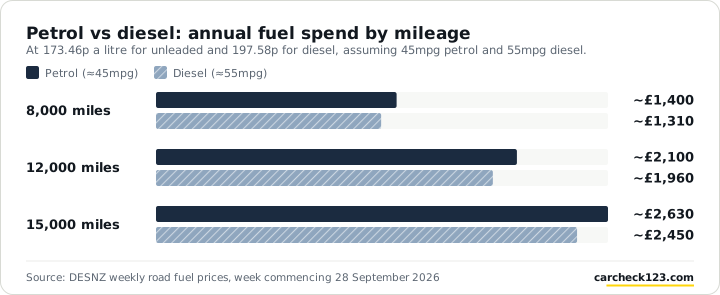
Take those pump prices and a reasonably efficient family car. Say 45mpg for petrol and 55mpg for diesel, both plausible for a modern mid-size car. The sums are simple.
| Annual mileage | Petrol (≈45mpg) | Diesel (≈55mpg) |
|---|---|---|
| 8,000 miles | ~£1,400 | ~£1,310 |
| 12,000 miles | ~£2,100 | ~£1,960 |
| 15,000 miles | ~£2,630 | ~£2,450 |
They're illustrative, built from today's pump prices and a stated mpg assumption. Your actual mpg and fuel cost depend heavily on the specific car, your driving style and how much of your mileage is motorway rather than town. A genuinely thirsty SUV or a stop-start city commute can easily push the real figure well above these numbers.
Electric vs petrol/diesel running-cost comparison
For electric cars, the comparison depends heavily on where you charge. Zapmap's Price Index put the UK weighted-average pay-as-you-go price in August 2026 at 54p/kWh on standard chargers up to 49kW, and 77p/kWh on rapid and ultra-rapid ones. Zapmap's own figures translate that to roughly 16p and 23p per mile respectively, on typical EV efficiency.
Home charging is a different story. Ofgem's domestic price cap puts the average Direct-Debit electricity rate across England, Scotland and Wales at 26.32p/kWh from October to December 2026. From July to September it was 26.11p/kWh.
Don't read that 0.2p rise as the whole story. The July to September figure included VAT at 5%. VAT came off household electricity in Great Britain on 1 October 2026 and stays off until 31 March 2027, so the underlying rate has risen more than the gap suggests. Both are what actually lands on your bill, though.
Using the same efficiency assumption that Zapmap applies to its public-charging figures, that works out at around 7–8p a mile. That's around half the petrol and diesel figures above, and cheaper still on a dedicated off-peak EV tariff.
Public rapid charging can cost more per mile than driving a diesel. The gap between home and rapid charging really is that wide. Where you'll charge matters more than which fuel type you pick.
Whatever you drive, our free car check gives you a running-cost estimate for a specific vehicle, plus the emissions-zone picture for it. Once you've got a real car in mind, that beats any of the averages on this page.
MOT and road tax costs
Two fixed costs. Neither is a big one.
The MOT test fee is capped at £54.85 for a standard car (Class 4). Garages can charge less, and many do, but they can't legally charge more. It's due every year once a car passes three years old.
Road tax (VED) for most cars registered from April 2017 onwards settles at a flat standard rate of £200 a year. That applies from the second year of registration, whatever the fuel type (electric cars now pay it too). Older cars use different systems based on CO2 bands or engine size.
Pricier cars carry an extra "expensive car supplement" on top. It's £440 a year, and you pay it for five years from the second time the car is taxed. It bites if the car's list price when new was over £40,000, or over £50,000 for an electric car.
Most used electric cars escape it, though. A zero-emission car registered before 1 April 2025 doesn't pay the supplement at all, whatever it cost new. Only EVs registered from 1 April 2025 onwards can be caught, and then only above £50,000. Rates are set every April and can change at a Budget.
Tax doesn't transfer when you buy a used car. You have to tax it in your own name before you drive it away, and you need a valid MOT to do that. Our guide to MOT, road tax and staying legal has the full VED band tables.
Before you agree a price for any used car, check its actual tax and MOT status rather than taking a seller's word for it.
Servicing and maintenance — budgeting for the unavoidable stuff
This is where "the average car costs £X a year" claims get shakiest. No UK trade body publishes an authoritative index for servicing costs. Instead, you'll find a patchwork of garage-chain and comparison-site price guides that don't always agree, and some visibly go stale. One well-known guide was still quoting 2021 pricing on a page dated 2026.
Routine servicing costs
Use current (2026) garage-price guides as a rough steer, not a settled figure. An interim service commonly runs £140–£170. A full service runs £170–£300, more for larger or premium cars, sometimes £400+. A major service runs £230–£400+.
Dealer servicing typically costs 25–40% more than the same job at an independent garage. Treat all of these as ballpark ranges to check a quote against, not a verified national average. I'd get quotes from a couple of local garages for the specific car you're looking at before calling any of it normal.
What a car's service history tells you about future costs
A full, itemised service history is one of the best clues to what a used car will cost you next. Look for invoices, not just stamps in a book. It shows what's been replaced (cambelts, clutches, brakes) and what's due next. A gap in the history, or a car that's clearly been serviced to the bare legal minimum, is a reason to budget more for the unknown, not less.
A dedicated guide to reading a service history properly, what "good" looks like and what gaps should make you nervous, is coming soon.
Depreciation — the cost you don't write a cheque for
By most reckonings, depreciation is the single biggest cost of owning a car. Bigger than fuel, bigger than insurance. It doesn't show up on a bank statement. That's why buyers underestimate it.
The broad pattern is well established. Used cars lose value fastest in their first few years, then more slowly as they get older. How quickly each one loses value varies hugely by make, model, mileage and condition. A popular, well-specced car in demand holds its value far better than a niche or unfashionable one.
The precise numbers you'll see quoted for "typical" depreciation vary wildly between sources, and they're easy to misapply to one specific car. So there's no percentage here. Our dedicated guide to depreciation covers the actual figures and what drives them.
One thing matters most if you're buying used. Buy a car that's already a few years old and the worst of the drop happened on someone else's watch. That's one of the strongest arguments for buying used at all. The car still loses value from here, though, so it's an ongoing cost rather than something that finished before you owned it.
Warranty options — what's covered, what isn't
A warranty doesn't reduce your running costs directly. It changes who pays if something goes wrong. That's the point of budgeting for running costs.
Manufacturer warranty transfer on a used car
Most new cars in the UK come with a manufacturer warranty of around three years, often up to a mileage limit such as 60,000 miles. Terms vary a lot by brand, and some manufacturers now offer five, seven or even more years. Buy a used car that's still within its original warranty period and that cover generally transfers to you as the next owner.
You get the remaining time and mileage, whichever runs out first. It doesn't reset. Check the exact terms for the specific make, because they differ.
Third-party/extended warranty — what it typically covers
Once the manufacturer's warranty has run out, a third-party or dealer extended warranty is optional. It typically covers mechanical and electrical failures for a set period or mileage, not routine wear items like tyres, brake pads or servicing. Cover levels vary a lot between providers. What's included and excluded matters more than the headline price.
Our full guide to used-car warranty options covers what's typically included, what isn't, and how to weigh the cost against the risk.
How running costs change as a car gets older, and how to check a specific car before you buy
You don't need hard numbers to see the general pattern. A newer used car tends to cost less in unplanned repairs, but more in depreciation and often insurance. An older car has usually shed most of its depreciation, but it's statistically more likely to need parts replacing. It can also need costlier repairs as components reach the end of their design life: suspension, electrics, emissions equipment.
A dedicated guide to how faults typically cluster by a car's age is coming soon. For now, "older is cheaper to buy, potentially pricier to keep" is the honest rule of thumb. It isn't a guarantee either way.
None of these averages tell you what one specific car will cost you. Our free car check is built to close that gap. Enter a number plate and it gives a running-cost estimate for that vehicle, with emissions-zone context alongside it.
You also get its MOT history, its current tax status and a wider vehicle-history timeline. Financial and write-off status sit behind our paid checks. The running-cost estimate itself is part of the free check.
Keep one thing in mind. Any figure a tool gives you before you enter a real plate and a real postcode is a starting point, not a quote.
The ABI average above is a different thing again. It's one national number across every comprehensive policy sold. So run the plate and your own details, rather than holding two averages up against each other.
FAQs
How much does it cost to run a used car in the UK per year?
There's no single headline figure that fits one particular car, so treat any bare "£X,XXX a year" claim you see elsewhere with caution. The closest published benchmark is the ONS Family Spending survey, at £33.70 a week per household for running personal transport. That's an average across all households, car or not, and nothing in it stands for depreciation. Build it from the sourced categories in this guide instead. Roughly £566 a year for insurance (ABI, Q2 2026). Then £1,310–£2,630 for fuel, depending on mileage. Then £200 for tax, and up to £54.85 for the MOT. Servicing is variable on top. That lands somewhere in the low thousands overall, before depreciation.
What's the single biggest ongoing cost of owning a used car?
Depreciation is usually the largest cost overall. You don't pay it directly, though. Of the costs you actually write a cheque for, fuel and insurance are typically the two biggest. That's roughly the order for most mileage levels.
Is it always cheaper to buy an older car if you're trying to keep running costs down?
Not always. An older car has usually shed most of its depreciation, and can be cheaper to insure. But it's statistically more likely to need repairs. Parts or specialist work can push individual bills higher too. A well-documented mid-age car with a full service history is often the sweet spot. That beats the oldest car you can find.
Does a used-car warranty cover routine servicing, or only breakdowns?
Usually, it covers breakdowns and mechanical or electrical failures only. Not routine wear items like tyres, brake pads or scheduled servicing. Cover varies a lot by provider. Check exactly what's included before relying on it.
How can I estimate the running costs of a specific used car before I buy it?
Run its number plate through our free car check. It includes a running-costs estimator alongside the car's MOT history and current tax status. Once you've got a specific car in mind, that's a far better starting point than any national average.
Do used electric cars cost less to run than petrol or diesel ones?
Usually, if you can charge mainly at home. Home charging works out at roughly half the typical petrol or diesel pence-per-mile cost on current prices, and less on a cheap off-peak tariff. Relying mainly on public rapid charging narrows that gap or even reverses it. Zapmap put rapid charging at 77p/kWh on average in August 2026, and that can cost more per mile than driving a diesel.