
What's different about buying a used EV
A used electric car needs every check you'd run on a petrol one. Write-off history, outstanding finance, the recorded mileage, the paperwork. Add four more: battery health, remaining warranty, charging, and road tax. Get those right, and a used EV can be cheap to own.
This page sits inside our guide to buying a used car. At a viewing, I'd do the checks in this order. Battery first, because that's the expensive thing to get wrong. Then warranty, charging, tax and the usual history checks.
Buying one that came off a lease? Our guide to buying an ex-lease used electric car covers what's different about those.
More buyers are doing this for the first time. The SMMT reported that used battery-electric (BEV) transactions grew 67.0% year-on-year in the second quarter of 2026, to 110,761 cars and 5.5% of the market. That's the strongest quarterly growth since early 2024, against a used market up just 0.7% overall.
Even so, that's about one buyer in 18, so most first-time used EV buyers still have nobody to ask.
For the full walk-through, see how to buy a used car in the UK.
Start with the battery: State of Health
The battery is the most valuable part of an electric car, so check it first. The figure to look for is its State of Health, or SoH. It's shown as a single percentage.
At 100%, the battery still holds all the usable capacity it had when new. At 80%, a fifth of that capacity has gone. As the figure drops, you lose range, not reliability. A faded battery doesn't mean a car that suddenly stops working.
Batteries fade gradually. They don't fail off a cliff.
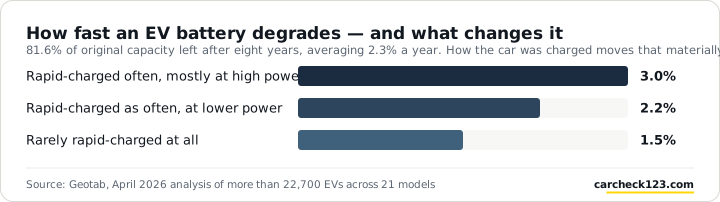
Those figures come from fleet telematics across 21 models. Treat them as the shape of the curve, not a promise about the car in front of you. For a used buyer, what matters is what changes the rate. Geotab grouped the cars three ways by how they'd been rapid-charged:
- Rapid-charged often, and mostly at high power: 3.0% degradation a year.
- Rapid-charged just as often, but at lower power: 2.2% a year.
- Rarely rapid-charged at all: 1.5% a year.
So ask how the car has been charged. It's a fair question at a viewing. A car that's lived on motorway rapid chargers deserves a closer look than one trickled up overnight on a driveway.
Three ways to check State of Health before you buy:
- Read it from the car. Many EVs show a battery health or SoH figure in the dashboard menus or the maker's app. That's the quickest place to start.
- Do a range check. Charge to 100% and compare the range the car shows against its original official range, the WLTP figure quoted when it was new. A big shortfall is worth asking about. Cold weather and driving style move that estimate around, so allow for both.
- Get a proper reading. An OBD2 reader (a plug-in diagnostic dongle) with the right app for the model, or an independent EV specialist, can pull a detailed SoH report. For a car costing thousands, that's money well spent.
Check the battery warranty, and whether it transfers
Most makers cover the battery for longer than the rest of the car. Eight years or 100,000 miles, whichever comes first, with a guaranteed minimum capacity of around 70%. That's the common shape.
Volkswagen, for example, warrants its EV batteries "up to 8 years or 100,000 miles from point of first registration (whichever comes first)". That's to "ensure your battery retains 70% of its original capacity".
Those are one maker's terms, not a universal rule. Some offer shorter periods, and the capacity floor varies. Check the brand you're buying instead of assuming.
Two things matter when you're buying used:
- How much cover is left. An eight-year warranty on a four-year-old car has four years to run, but only if the mileage cap hasn't been passed first. Work out both. A high-mileage three-year-old car can be out of battery cover before an older, gentler-used one.
- Whether it transfers to you. Battery cover is normally attached to the car rather than the first owner, so it passes on when the car is sold. Volkswagen says its cover "can be passed on to future owners". Not every manufacturer treats it the same way. Check the remaining term, the mileage cap and transferability with the manufacturer using the car's VIN before you rely on the cover.
Replacing a battery outside warranty is expensive. I won't put a figure on it: the ranges quoted online have no clear source and vary widely by model.
What's fair to say is that it can run to thousands of pounds. That's why the health check and the warranty status are worth getting right before you buy, not after.
Work out how, and how much, you'll charge it
Whether a used EV makes sense depends on running costs and where you plug in.
Charging at home is much cheaper. Domestic electricity carries the reduced 5% rate of VAT, per gov.uk. HMRC's position is that public charge points are standard-rated at 20%. It restated that in Revenue and Customs Brief 4 (2026) in May 2026, after a tribunal decision partly went the other way and HMRC applied for permission to appeal.
The tax treatment of public charging may change, but 20% applies today. Add the higher headline prices on rapid chargers and public rapid charging is the priciest way to fuel an EV.
Check that the charging plug matches, too. In the UK, EVs use a Type 2 connector for home and slower AC charging, and CCS for DC rapid charging. Nearly all modern EVs take both, but it's worth a five-second look.
The government's chargepoint grant covers "75% off the cost of buying and installing a socket, up to a maximum of £500". That applies if you rent a residential property or you own and live in a flat, and you have your own private off-street parking space. A homeowner with an ordinary private driveway isn't eligible for that one.
There's a separate grant for households that only have on-street parking and are installing a cross-pavement solution such as a charging gully. Check gov.uk's chargepoint grants list to find which scheme, if any, fits your situation.
Yes, you still pay road tax on an electric car
Electric cars were once exempt from road tax (Vehicle Excise Duty). That exemption ended on 1 April 2025. Any guide saying EVs are free to tax is out of date.
What a used EV costs to tax depends on when it was first registered. Per gov.uk, for the tax year to March 2027:
- Registered between 1 March 2001 and 31 March 2017: the standard rate of £20 a year.
- Registered 1 April 2017 to 31 March 2025: the standard rate of £200 a year.
- Registered on or after 1 April 2025: £10 for the first year, then the £200 standard rate.
Pricier EVs have one extra catch. The Expensive Car Supplement adds £440 a year for five years, starting from the second time the car is taxed. It applies to electric cars registered on or after 1 April 2025 with a list price over £50,000.
That threshold rose from £40,000 to £50,000 on 1 April 2026 for zero-emission cars specifically. It stays at £40,000 for everything else.
Our free car check shows whether a car's road tax is current, and the date it runs out, from the registration.
But that date is the current keeper's tax. Gov.uk says "the tax is not transferred to you when you buy the vehicle", so you must tax it yourself before you drive it away.
Don't skip the checks you'd do on any used car
An electric car can hide exactly the same history as a petrol one. Battery-obsessed checklists miss this bit. Before you hand over money, check:
- It hasn't been written off. An EV can be a repaired insurance write-off (Cat S or Cat N) like anything else. Our guide to car history checks explains what the categories mean. A repair doesn't remove the marker.
- There's no outstanding finance. If the seller still owes money on the car, you can end up arguing with a finance company about who owns it. A private buyer who buys in good faith, with no notice of a hire-purchase or conditional sale agreement, is generally protected by Part III of the Hire-Purchase Act 1964 and can gain good title. That protection doesn't stretch to every kind of secured lending, though, and having to rely on it is a fight worth avoiding. Our guide to outstanding finance explains where you stand.
- The mileage is genuine. Clocking happens on EVs too. Cross-check the recorded mileage against the MOT and service history.
- It isn't recorded as stolen. A stolen-car check is the same job on an EV as on anything else.
Our free car check shows the MOT history, recorded mileage and tax status from just the number plate. The write-off category, outstanding finance and stolen markers sit behind our Comprehensive check. You can see a sample Comprehensive check report before you buy one.
Any check shows the car as it stands when you run it. So if weeks pass between checking and buying, run a fresh check before you hand over money.
A few physical checks still matter. Two work differently on an EV:
- Tyres. An electric car is usually heavier than the petrol equivalent, which tends to push tyre wear up. Check tread and condition. A new set isn't cheap, and EVs often use wide, expensive sizes.
- Brakes. EVs tend to do better here. Regenerative braking does much of the slowing, so pads and discs often wear less than on a comparable petrol car. Check they haven't corroded from light use, though.
- Service history and MOT record. An EV has less to go wrong mechanically, but it still needs servicing. Look for a consistent record and a clean recent MOT.
There's no grant for a used electric car
There's one myth to clear up. Government EV grants don't apply to used cars. The Electric Car Grant opened to manufacturers on 16 July 2025.
The grant takes up to £3,750 off eligible new electric cars priced at or under £37,000, or £1,500 for cars in the lower sustainability band. The older Plug-in Car Grant closed for cars in June 2022 and is now available only for wheelchair accessible vehicles.
A used EV's saving isn't a grant. It's the lower purchase price, because the first owner has already paid the difference between new and used. Add cheaper running costs if you can charge at home.
FAQs
How do I check the battery health of a used electric car?
Look for the State of Health (SoH) reading in the car's menus or the maker's app. Charge to 100% and compare the range shown against the model's original official figure. For a clear figure, use an OBD2 reader or an independent EV specialist. If the seller blocks all three, that's your answer: don't buy the car.
What's a good battery State of Health for a used EV?
There's no official pass mark, so treat it as a rule of thumb. A healthy battery should still hold the large majority of its original capacity. For context, Geotab's April 2026 analysis of more than 22,700 EVs found average degradation of 2.3% a year. That works out at roughly 82% capacity left after eight years. What matters most is whether the car in front of you has degraded faster than that for its age and mileage.
Do you have to pay road tax on an electric car now?
Yes. EVs lost their road-tax exemption on 1 April 2025. For the tax year to March 2027, a used EV registered between March 2001 and March 2017 pays £20 a year. One registered between April 2017 and March 2025 pays the £200 standard rate.
Does the battery warranty transfer to me if I buy used?
Usually. Battery cover is normally tied to the car rather than the original owner, so the remaining term passes to you. But terms differ by manufacturer, and the mileage cap may already have been passed. Check both with the manufacturer using the car's VIN rather than taking the seller's word for it.
Can I get a government grant for a used electric car?
No. The Electric Car Grant applies only to eligible new electric cars priced at or under £37,000, and the old Plug-in Car Grant closed for cars in June 2022. There's no equivalent scheme for used EVs.
What's the single most important thing to check on a used EV?
The battery's State of Health and how much warranty is left on it. That's the expensive thing to get wrong. Then run the same history check you'd use for any used car: write-off category, outstanding finance, mileage and stolen markers.