
How much more does a private sale actually get you?
On average, selling privately gets you more than part-exchanging. But the honest answer to "how much more" is less than you've been told. It depends heavily on the car.
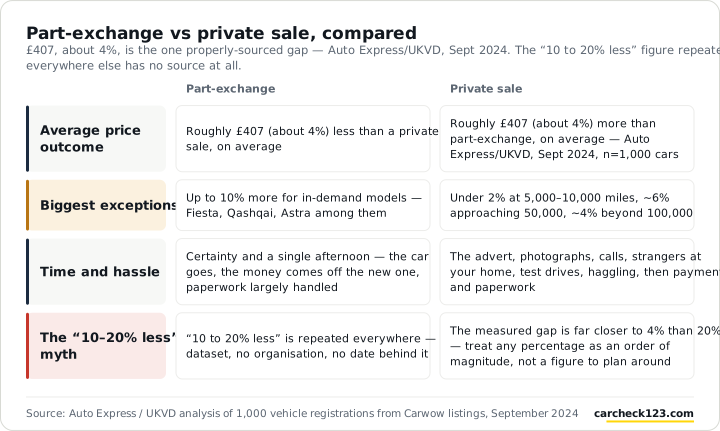
Only one comparison we found sets out its method. In September 2024, Auto Express analysed 1,000 vehicle registrations from Carwow listings. The market estimates came from data specialist UKVD.
From budget cars to luxury models, the average difference came out at £407 in favour of the private sale. That's "an average bonus of almost 4 per cent on the selling price."
Mileage moves that number more than anything else. The private-sale advantage was under 2% at 5,000 to 10,000 miles. It was almost 6% approaching 50,000, and around 4% from there up past 100,000.
I'd treat 4% as a rough guide, not a figure to plan around. It's one dataset from one marketplace's listings, now getting on for two years old. Carwow quotes the same UKVD research as "around £400 more". That's one study cited twice, not independent confirmation.
The "10 to 20% less" figure you'll see everywhere
Plenty of car sites say that part-exchange pays "10–20% less", or "15–20% below", a private sale. We went looking for the source. Every page that states it makes a bare assertion, with no dataset, no organisation and no date.
It's folklore, copied between sites for years. The gap is real, but far closer to 4% than 20%.
This guide is part of our wider advice on selling your car. For the overview, see selling your car: the complete UK guide.
Why a part-exchange offer comes in lower
It isn't that dealers are stingy. They're quoting a different number from the one you're comparing it against.
The trade prices the same car several ways. Auto Trader defines a trade valuation as what a car is worth "if listed for trade between dealers — effectively the value of the vehicle excluding any margin". A private valuation is what the same car is worth "if listed by a private seller". cap hpi sells trade values and retail values as separate products.
So a dealer doesn't start from the forecourt prices you've been browsing. A dealer-side guide to the process puts it plainly: "start with a trade or wholesale valuation, not a retail one". The same guide says to adjust "for the specific car in front of you: mileage against the guide average, condition, spec, service history".
Then they take off the cost of preparing it for sale: valet, MOT work, tyres, brakes, cosmetic repairs. What's left is your offer.
A past write-off, a thin service record or a mileage question mark all get marked down at that adjustment stage. That goes for a dealer and a private buyer alike. Our guide to insurance write-off categories covers how much those markers matter.
When part-exchange actually beats a private sale
The average hides the cars that go the other way. It's a bigger group than you'd think. In the same analysis, certain variants of in-demand mainstream models did up to 10% better via part-exchange, in Auto Express's own figures.
The examples named were the Nissan Micra and Qashqai, Mercedes C180, Ford Fiesta, Vauxhall Astra, MINI One, SEAT Ibiza and Ford Focus. Dealers want those cars because they know they'll shift, so they bid harder to get one.
Low mileage narrows the gap too: under 2% at 5,000 to 10,000 miles. On a £12,000 car that's about £230 for weeks of adverts, calls and viewings.
Watch the two numbers together, though. HMRC's VAT valuation manual describes a practice it calls "bumping": the dealer "increasing the value of the car he is selling as well as increasing the allowance" for the part-exchange. A generous trade-in figure can be funded by a smaller discount on the car you're driving away in. Judge the deal on what you hand over in total.
What about WeBuyAnyCar, Motorway and cinch?
We can't give you a number for this route. Nobody has published one worth quoting. There's no independent, method-disclosed comparison of instant-buying services against private sale prices.
Instead, there's the services' own marketing. Motorway states its sellers "make £1,600 more than part exchange on average". Its source is a survey of 589 of its own customers in April 2026. Beyond that, forum anecdotes put the gap anywhere from single digits to 40%.
What we can say without guessing: these services sell into the trade. So they work from trade values much as a part-exchanging dealer does. Get quotes from two or three. Compare them with a dealer's offer, and treat those numbers as your evidence.
One detail often gets muddled here: cinch takes your car as a part-exchange against one of its own, not as a standalone cash purchase. It belongs in the part-exchange column above.
Do you pay VAT either way?
No. VAT isn't a factor in this decision for a private individual. It doesn't favour either route.
VAT registration applies to business turnover. You must register when "your total taxable turnover for the last 12 months goes over £90,000", per gov.uk. Selling a car off your own driveway isn't business turnover, so you charge no VAT either way.
The VAT machinery sits on the dealer's side afterwards. HMRC lets them use a margin scheme for vehicles bought from private individuals and non-VAT-registered businesses. Under it they account for VAT "on the difference between the price you pay for a second-hand vehicle and the price you sell it for". That's their sum, not yours.
One point if you're buying at the same time. Part-exchanging doesn't reduce the VAT on the car you're buying. HMRC treats a trade-in as part of the payment. So the value of the supply, which is what VAT is actually charged on, is the full price before your allowance comes off.
Check your own car before you commit to either route
Whichever way you go, your car's recorded history is part of its price. A dealer adjusts for condition, mileage and service history before giving you a figure. A private buyer runs their own check before handing over several thousand pounds.
What usually trips sellers up isn't their own doing. It's a write-off marker from an owner before you, a mileage entry that doesn't line up, a plate change with no explanation. Run a comprehensive check on your own registration first, and you'll find out before they do. Then you can either sort it or price for it.
Outstanding finance needs the most care. Under hire purchase or conditional sale, Citizens Advice is blunt. It says "you don't own the goods until you have paid in full" and "you aren't allowed to sell or dispose of the goods without the lender's permission. If you do, you'll be committing a criminal offence."
A dealer will normally settle finance as part of a part-exchange. Privately, that's on you, and our guide to outstanding finance explains how settlement works.
A check is a point-in-time snapshot. It shows the car as the records stood the moment you ran it, and never updates itself. So run a fresh one if weeks pass before you sell. You can see what's covered in the sample report before buying a comprehensive check.
Time, hassle and certainty — the part the numbers miss
Once you have a real part-exchange offer and a realistic private asking price, the decision becomes an hourly rate. On a typical car, a 4% advantage is a few hundred pounds. Against that, you've got the advert, the photographs, the calls, strangers at your home, test drives, haggling, then payment and paperwork.
Part-exchange buys certainty and a single afternoon. The car goes, the money comes off the new one, and the paperwork is largely handled. For a low-mileage or in-demand car, that convenience can cost you almost nothing.
Private selling is worth the effort where the gap is widest. That means a higher-mileage car, a well-kept one with a full history worth showing off, or a model dealers aren't queuing up for. Our guide to selling privately covers doing it safely.
FAQs
Can I negotiate a part-exchange price?
Yes, but negotiate the whole deal rather than that one number. HMRC's VAT valuation manual documents dealers raising the part-exchange allowance and the price of the car being sold together. So a better trade-in figure can just mean a smaller discount elsewhere. Judge it on the total cash you have to find.
Is part-exchange worth it for an older or high-mileage car?
The gap tends to be widest at higher mileages. In the UKVD data behind Auto Express's September 2024 analysis, the private-sale advantage ran from under 2% at 5,000 to 10,000 miles. It ran to almost 6% approaching 50,000. On a cheaper car, though, a bigger percentage can still be modest money once you've paid for adverts.
What's the difference between trade value and private sale value?
They're separate published valuations of the same car. Auto Trader defines a trade valuation as what a car is worth "if listed for trade between dealers — effectively the value of the vehicle excluding any margin". A private valuation is what it's worth "if listed by a private seller". A part-exchange offer comes from the trade end. That's why it never matches a forecourt price.
Do I pay VAT if I part-exchange my car?
No. As a private individual you aren't VAT-registered, since registration applies to business turnover above £90,000. So you charge no VAT either way. The dealer accounts for it afterwards under HMRC's margin scheme. Part-exchanging also doesn't cut the VAT on the car you're buying: HMRC treats your trade-in as payment, not a discount.